
Solitude vs. Loneliness: The Ultimate Guide to the Habit of Spending Time Alone
It is Friday night, and your calendar is completely empty.
For some, this realization feels like a heavy, suffocating blanket. The apartment is too quiet, the hum of the refrigerator is too loud, and the glowing screen of your smartphone feels like your only tether to the outside world.
This creeping anxiety is the exact battlefield where the war of solitude vs loneliness is fought.
You might instinctively reach for your phone to numb the silence. You might scroll through endless feeds of other people living their seemingly perfect lives, which only deepens the ache in your chest. But what if you could flip this script entirely?

What if an empty evening wasn’t a punishment, but a profound privilege?
Understanding the difference between solitude vs loneliness is the hidden key to unlocking unshakeable self-reliance. It is the crucial pivot from feeling abandoned by the world to intentionally choosing yourself.
By the end of this definitive guide, you will no longer fear the quiet moments. You will learn the psychological secrets to transforming painful isolation into empowering solitude, and we will break down the exact habits you need to build a life where you are your own favorite company.
The Psychology of Solitude vs Loneliness: Why Being Alone Doesn’t Mean Being Lonely
To master the habit of spending time alone, we must first dissect the fundamental psychology behind the solitude vs loneliness paradigm. They look identical from the outside, but chemically and emotionally, they are entirely different universes.
Loneliness is a state of perceived deprivation. It is an evolutionary alarm bell ringing in your brain, warning you that you are isolated from the tribe and therefore in danger.
According to research highlighted by the American Psychological Association, chronic loneliness triggers cortisol release, elevating stress and putting your nervous system into fight-or-flight mode. You can feel profoundly lonely in the middle of a crowded room or while sleeping next to a partner.
Solitude, however, is a state of intentional engagement with yourself.
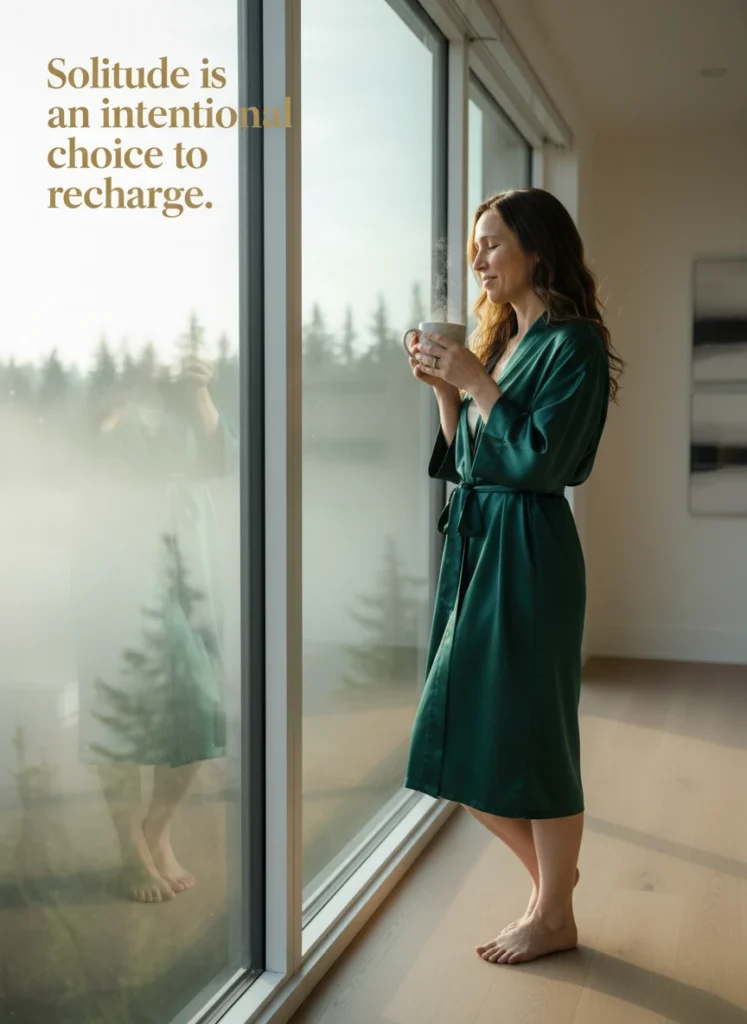
It is a conscious choice to step away from the noise of society to recharge, reflect, and rebuild. When you practice intentional solitude, your brain shifts out of reactive survival mode and enters the “Default Mode Network” (DMN).
This neurological network, as detailed by researchers at Harvard Business Review, is where your brain processes deep emotions, connects disparate ideas, and fosters profound creativity. Solitude is the fertile soil where your highest self takes root.
The bridge between these two states is simple: Intentionality.
When you wait for someone else to fill your time, you are a victim of circumstance, breeding loneliness. When you proactively schedule time with yourself, you become the architect of your reality.
This shift is the cornerstone of building genuine, intrinsic self-worth. Once you realize that your own company is inherently valuable, you stop seeking external validation to justify your existence.
Decoding the Cultural Struggle: The Solitude vs Loneliness Paradox
Why is it so incredibly difficult for us to just sit alone in a room?
Modern society has conditioned us to view busyness as a badge of honor. We are taught that a full social calendar equates to a successful life. Therefore, when we find ourselves alone, we suffer from cognitive distortion.
We immediately assume, “If I am alone, it means nobody wants to be with me.”
This is a toxic societal narrative designed to keep you consuming, reacting, and performing for others. It fuels the fear of missing out (FOMO) and keeps you trapped in the comparison cycle.
But true power lies in breaking this conditioning.

When you conquer the solitude vs loneliness paradox, you reclaim your energy. You stop performing for an audience and start living for yourself. This is the foundation of true emotional resilience, and it requires deliberate, repeated practice.
Let’s dive into the exact blueprint for making this transformation.
10 Steps to Master the Habit of Spending Time Alone (And Win the Solitude vs Loneliness Battle)
Transitioning from fearing the quiet to craving it will not happen overnight. It requires habit building, psychological reframing, and intentional action.
Here are ten exhaustive steps to master the solitude vs loneliness dynamic and make spending time alone your most powerful habit.
Step 1: Reframe the Narrative from Abandonment to Autonomy
The first battle in the solitude vs loneliness war is fought entirely in your mind.
When you find yourself alone, your inner critic might whisper that you have been left behind. You must aggressively intercept this thought. You are not experiencing abandonment; you are exercising autonomy.
To do this, you must change your internal vocabulary. Stop saying, “I have nothing to do today.” Start saying, “I have claimed today entirely for myself.”
This subtle shift in language rewires your neural pathways. It takes you out of the passenger seat and puts you firmly behind the wheel. If you struggle with this voice telling you that you aren’t enough when you’re alone, you must actively silence your inner critic using cognitive reframing techniques.
Step 2: Implement “Planned Idleness” to Cure Solitude vs Loneliness
You cannot expect to suddenly enjoy being alone if you only do it when your plans fall through. That makes solitude the backup plan, the consolation prize.
To win the solitude vs loneliness struggle, solitude must become the main event.
You need to schedule what psychologists call “Planned Idleness.” Block out two hours on your calendar this Sunday. Treat this appointment with the exact same gravity you would a meeting with your boss or a date with a partner.
During this time, you have no goals, no to-do lists, and no obligations. This is the essence of the planned idleness habit, where the act of doing nothing becomes your highest priority. By scheduling it, you tell your subconscious mind that your alone time is sacred.

Step 3: The Digital Fast (Disconnecting to Reconnect)
You are not truly alone if you are scrolling through TikTok, Instagram, or reading the news. You are simply inviting thousands of strangers into your quiet space.
To understand true solitude vs loneliness, you must remove the digital pacifier.
Smartphones provide cheap, instant dopamine hits that mask the discomfort of loneliness without ever actually curing it. When you put the phone in another room, the silence will feel deafening at first. The anxiety will spike. This is normal.
According to experts on digital well-being at the Mayo Clinic, pushing through this initial withdrawal phase is crucial for resetting your baseline dopamine levels.
Commit to a strict digital minimalism detox during your solitude hours. Turn off the Wi-Fi. Put the phone in a drawer. Let the silence wrap around you until it stops feeling like a threat and starts feeling like a warm embrace.
Step 4: Cultivate “Main Character Energy” in Isolation
One of the fastest ways to cure the pain of loneliness is to romanticize your solitude.
Loneliness feels like you are an extra in a movie where everyone else is having fun. Solitude feels like you are the star of an indie film, beautifully navigating the complexities of your own inner world.
Put on a luxurious robe. Make a meticulously crafted cup of pour-over coffee or loose-leaf tea. Play a curated playlist of jazz or acoustic guitar.
When you elevate the mundane moments of being alone, you naturally cultivate main character energy. You signal to yourself that you are worth the good china, the expensive candle, and the beautiful music, even when no one else is watching.
Step 5: Master the “Solo Date” Protocol
Spending time alone at home is level one. Level two in mastering the solitude vs loneliness dynamic is taking yourself out into the world.
The fear of being perceived as lonely in public keeps millions of people trapped in their homes. We are terrified that a stranger will see us eating alone and pity us. But overcoming this deep-seated fear of judgment is incredibly liberating.
Start small. Take yourself to a local coffee shop with a book. Once you conquer that, escalate to a museum, a movie theater, and eventually, a sit-down dinner at a nice restaurant.

When you take yourself on a date, dress up. Dress exactly how you would if you were trying to impress a romantic partner. By doing this, you vividly demonstrate to your subconscious that you are a high-value companion.
Step 6: Confront the Shadow in the Solitude vs Loneliness Void
Why do we run from solitude? Because when the noise stops, the suppressed emotions rise to the surface.
If you have been avoiding grief, anxiety, anger, or past trauma, it will inevitably knock on the door the moment you are alone. This is where loneliness feels agonizing. It forces you to look at the parts of yourself you have abandoned.
Instead of running back to distractions, invite these feelings in.
Use your time alone to actively process your internal landscape. This is the perfect time to engage in deep, reflective shadow work journaling. Write down the fears that arise. Question the anxieties.
When you stop running from your own mind, the desperate need for external distraction vanishes. You realize that your mind is a safe place to inhabit.
Step 7: Create a Solitude Sanctuary
Your environment heavily dictates your psychological state.
If your home is chaotic, cluttered, and stressful, being alone in it will feel like a punishment. To shift the solitude vs loneliness balance in your favor, you must curate a physical space that invites peace.
Designate a specific corner of a room exclusively for your alone time.
Keep it exceptionally clean. Add soft textures, warm ambient lighting (like a salt lamp or a warm-bulbed floor lamp), and things that engage your senses comfortably.
When you physically organize your space for mental clarity, you create a visual anchor. Just sitting in that chair will signal to your nervous system that it is time to down-regulate and enjoy your own company.
Step 8: Build the “Two-Day Rule” for Solitude vs Loneliness Habits
Habit formation requires consistency, but rigid perfectionism can cause you to quit altogether.
If you decide you are going to spend an hour alone meditating and journaling every single day, you will eventually miss a day. The inner critic will tell you that you failed, and you will revert to your old distracted behaviors.
Instead, apply the psychological framework of the two-day rule for habits.
The rule is simple: You can skip your intentional solitude practice for one day if life gets busy, but you must never skip two days in a row. This creates sustainable momentum. It forgives the occasional chaotic Tuesday but ensures you get back on track by Wednesday.
Step 9: Reclaim Your Creative Play
Loneliness is stagnant. Solitude is deeply creative.
When we are alone, we often feel the pressure to be productive—to clean the house, answer emails, or hustle. But true solitude requires an element of play.
You need to find an activity that you do purely for the joy of doing it, with zero intention of monetizing it or showing it to the world.
Paint terribly. Write bad poetry. Learn to play three chords on a cheap ukulele. Dance in your kitchen.

When you engage in creative play, you tap directly into your core essence. If you aren’t sure where to begin, starting an art journal for beginners is a magnificent way to combine tactile creativity with mindful solitude. It removes the pressure of perfection and invites pure exploration.
Step 10: The Ultimate Solitude vs Loneliness Journal Spread
To cement this transformation, you need a tangible tool to track your progress.
Journaling is the ultimate companion for solitude. It takes the swirling, overwhelming thoughts of loneliness and pins them down onto the page where they can be observed logically.
Create a dedicated “Solitude vs Loneliness” spread in your notebook.
Divide the page into three columns.
- Column 1: The Trigger. (e.g., “Saw a group of friends laughing on Instagram.”)
- Column 2: The Loneliness Narrative. (e.g., “I am unlovable, and I will always be excluded.”)
- Column 3: The Solitude Reframe. (e.g., “I am choosing to protect my peace tonight. I have the freedom to do exactly what I want without compromise.”)
Whenever the panic of loneliness strikes, open this spread. By forcing your brain to articulate the difference, you short-circuit the emotional reaction. This is the power of cognitive distortions management, turning overwhelming emotions into manageable data.
Designing Your Solitude Space: Tools and Setup for Spending Time Alone
Mastering the solitude vs loneliness dynamic is not just about mindset; it is also about the tactical tools you use to anchor yourself in the present moment.
If you sit in a brightly lit, sterile room with a blank wall, your mind will naturally seek escape. You must design an atmosphere that seduces you into staying present.
First, consider the lighting. Overhead, fluorescent lighting triggers the cortisol response, making you feel alert and agitated. Swap this for “ambient layering.” Use table lamps, string lights, or a single candle. The warm glow mimics a firelight, which evolutionary psychology tells us is a safe, communal space for reflection.
Second, upgrade your analog tools.
When you put your phone away, your hands will literally twitch for something to hold. Satisfy this tactile craving with high-quality analog materials. Invest in a heavy, thick-papered journal. Buy a fountain pen or a smooth-gliding gel pen that makes writing feel like a physical luxury.
The friction of pen on paper forces your brain to slow down to the speed of your hand.
Finally, incorporate auditory anchors. If the silence of the solitude vs loneliness gap is too intimidating, don’t force absolute quiet. Use a white noise machine, play a loop of rain sounds, or put on instrumental lo-fi beats.
The goal is to create a sensory cocoon. When you pair an emotionally safe mindset with a physically comforting environment, the desire to run away from yourself completely evaporates. You stop looking for an exit door and start settling into the room.
Conclusion: Embracing Solitude vs Loneliness for a Richer Life
The journey from fearing an empty Friday night to fiercely protecting your alone time is one of the most profound transformations you can undergo.
The solitude vs loneliness battle is not won by forcing yourself into isolation, but by gently welcoming yourself back home. It is about realizing that the person you have been running away from—yourself—is actually the most fascinating, comforting, and reliable companion you will ever have.
When you stop outsourcing your emotional regulation to a busy calendar, you become truly unshakeable.
The world can no longer threaten you with isolation, because you have already mastered the art of being beautifully, intentionally alone.
Take out your calendar right now. Block out two hours for this coming weekend. Protect that time ruthlessly. Put the phone in a drawer, light a candle, open your journal, and finally introduce yourself to the person you are destined to become.

For more guidance on cultivating this deep inner relationship, explore how to truly be your own best friend and watch as your entire reality shifts from scarcity to abundant peace.


