How to Stop Catastrophizing: Managing Worst-Case Scenario Thinking
It usually happens when you least expect it.
A vague email from your boss reading, “Can we chat later?” A text message left on “Read” by your partner for three hours. A sudden, unexpected twinge in your lower back.
In a fraction of a second, your mind boards a bullet train to the darkest possible destination.
That vague email? You are definitely getting fired. You won’t be able to pay rent. You will lose your apartment.
That unanswered text? They are losing interest. They are planning to leave you. You are going to end up entirely alone.
This rapid-fire escalation is called catastrophic thinking. It is exhausting, it is terrifying, and it drains the joy from your daily life. But here is the profound truth: you are not broken, and you can learn how to stop catastrophizing.

In this ultimate guide, we are going deep into the mechanics of your mind. We will explore why your brain defaults to the worst-case scenario, and more importantly, how to stop catastrophizing using proven, psychological techniques.
If you are ready to reclaim your peace and stop letting your imagination hold you hostage, you are in exactly the right place. Let’s begin by understanding your cognitive distortions.
The Psychology: Why Do We Catastrophize?
Before you can stop catastrophizing, you must understand why your brain does it in the first place.
You might think your mind is working against you. In reality, it is trying desperately to protect you. Catastrophizing is an evolutionary survival mechanism gone incredibly wrong in the modern world.
Thousands of years ago, assuming the worst kept our ancestors alive. If a bush rustled, the human who assumed it was a deadly tiger survived. The human who assumed it was just the wind did not.
Your brain is hardwired for a negativity bias. However, in our modern world, there are very few actual tigers.
The Amygdala Hijack
When you experience a trigger—like a missed deadline or a critical comment—your brain’s fear center, the amygdala, lights up.
According to Harvard Medical School’s research on the stress response, the amygdala sends a distress signal to the hypothalamus, flooding your body with cortisol and adrenaline. Your logical brain, the prefrontal cortex, effectively goes offline.
You literally lose the biological ability to think rationally.
This is why trying to simply “think positive” when you are in a panic spiral never works. To truly stop catastrophizing, you have to bypass the panic and speak the language of safety to your nervous system.
It becomes difficult to tell the difference between a real threat and a perceived one. This is the classic battle of intuition vs anxiety.
To stop catastrophizing, we must rewire this automatic loop. We need to train the brain to pause, evaluate the data, and gently steer the train back to reality.
9 Actionable Steps: How to Stop Catastrophizing Today
Learning how to stop catastrophizing is not an overnight fix. It requires building a new mental muscle.
Just like going to the gym, the first few times you try these techniques, they will feel heavy and unnatural. But with repetition, you will build emotional resilience.
Here is your comprehensive, step-by-step blueprint to stop catastrophizing and manage worst-case scenario thinking.
Step 1: Label the Thought to Stop Catastrophizing
The moment you realize you are spiraling, you must interrupt the pattern.
You cannot stop a moving train if you don’t realize you are on it. The very first step to stop catastrophizing is radical self-awareness.
When your heart starts racing and the “what ifs” begin, say out loud: “I am catastrophizing right now.”

Psychologists refer to this as “affect labeling.” By naming the emotion or the cognitive distortion, you instantly begin moving blood flow away from the emotional center of your brain and back into the logical prefrontal cortex.
What to avoid: Do not judge yourself for the thought. The goal is not to shame yourself for panicking. The goal is simply to observe the panic like a scientist looking through a microscope.
Step 2: The “Where is the Evidence?” Test
When you want to stop catastrophizing, you must become a ruthless defense attorney for your own mind.
Anxiety is an excellent liar. It presents feelings as facts. Your job is to demand proof.
Take out a piece of paper and draw a line down the middle. On the left side, write down your catastrophic thought. On the right side, write down the undeniable, objective evidence that supports this thought.

Let’s use the vague email from your boss as an example.
- The Thought: “I am getting fired today.”
- The Evidence: “My boss wants to talk. That is the only fact. Last week, she praised my project. I have never received a formal warning.”
Research published by the National Library of Medicine shows that Cognitive Behavioral Therapy (CBT) techniques like this are highly effective in reducing chronic worry. You are forcing your brain to look at the data, rather than the drama.
For more about this topic, read: Recommended Reading: Journal Prompts for Perfectionists
Step 3: Play the Tape Forward (The “Then What?” Technique)
One of the most powerful ways to stop catastrophizing is to actually lean into the fear.
Catastrophizing usually stops at the disaster. Your brain screams, “I’m going to lose my job!” and then the mental movie freezes on an image of you living in a cardboard box.
To break the spell, you must press play and force the movie to keep going. Ask yourself: “And then what would happen?”
If you lost your job… then what?
- I would feel terrible for a few days.
- Then what?
- I would file for unemployment and update my resume.
- Then what?
- I would reach out to my network and go to interviews.
- Then what?
- I would eventually get another job.
By playing the tape forward, you remind yourself of your own resilience. You survived 100% of your bad days so far. You are capable of reframing failure as data and rising again.
Step 4: Re-Anchor in the Present Body
You cannot stop catastrophizing if your body still believes it is being chased by a bear.
Catastrophic thoughts live in the future. Your physical body lives in the present. To stop catastrophizing, you must unite the two.
When the spiral hits, use the 5-4-3-2-1 grounding technique, a mindfulness practice endorsed by experts at the Mayo Clinic.
Look around your immediate environment and name out loud:
- 5 things you can see.
- 4 things you can physically feel (the chair beneath you, the fabric of your shirt).
- 3 things you can hear (the hum of the fridge, traffic outside).
- 2 things you can smell.
- 1 thing you can taste.

This acts as a circuit breaker for your nervous system. It pulls you out of the imaginary future and plants you firmly in the safe, boring, and quiet present moment.
Step 5: The “What If It Works Out?” Pivot
Once you have grounded your body, it is time to flip the script.
Catastrophizing is essentially your brain using its imagination to torture you. To stop catastrophizing, we must use that exact same imagination to heal you.
For every worst-case scenario your brain invents, force it to invent a best-case scenario.
If your brain says, “What if my partner leaves me?” Force it to ask, “What if we actually grow closer and build a beautiful life together?”
If your brain says, “What if I bomb this presentation?” Force it to ask, “What if I crush this presentation and get a standing ovation?”

It might feel silly at first. But by introducing the best-case scenario, you are reminding your brain that multiple realities are possible. The worst-case is not a guaranteed prophecy.
Step 6: Accept Uncertainty to Stop Catastrophizing
At its core, catastrophizing is a desperate attempt to control the uncontrollable.
Your brain hates uncertainty. It would rather invent a terrible, painful narrative than sit in the discomfort of simply not knowing.
To truly stop catastrophizing, you have to embrace uncertainty.
You must practice saying this phrase: “I do not know what is going to happen, and I am willing to let it unfold.”
Life is inherently unpredictable. The energy you spend trying to predict the future is entirely wasted. Release your grip on the outcome, and trust that whatever happens, you have the tools to handle it.
Step 7: Schedule Dedicated “Worry Time”
If you try to completely banish anxious thoughts, they will only knock louder.
A brilliant psychological trick to stop catastrophizing all day long is to give your anxiety an appointment.
Set a timer for 15 minutes at a specific time of day—say, 4:00 PM. This is your “Worry Time.”
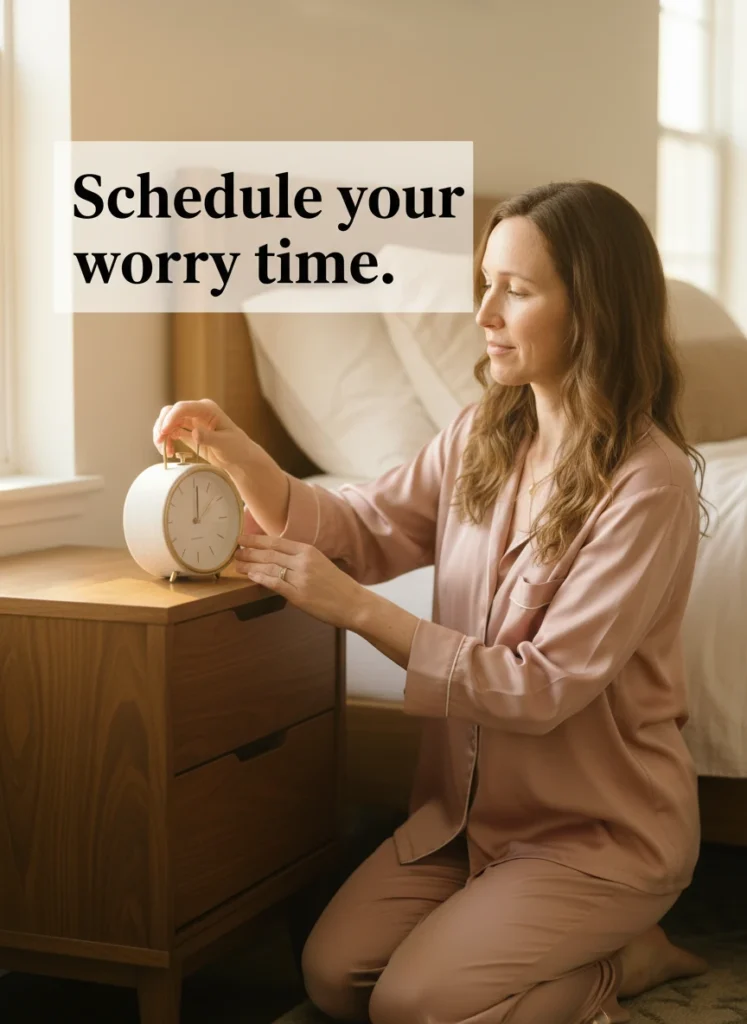
During this window, you are allowed to panic. You can write down every worst-case scenario. You can catastrophize to your heart’s content.
But when the alarm goes off, Worry Time is over. If a catastrophic thought pops up at 10:00 AM, you simply tell your brain, “I hear you, but we are going to worry about that at 4:00 PM.”
This teaches your brain that it is safe to delay anxiety. You are not ignoring the fears; you are just organizing them.
Step 8: Use The “Catastrophe Decoder” Journal Spread
Journaling is one of the most effective tools to stop catastrophizing. Getting the thoughts out of your head and onto paper strips them of their power.
If you are looking for journaling for anxiety relief, try drawing this specific spread in your notebook.
Divide a blank page into four distinct quadrants.
Quadrant 1: The Trigger
- What exactly happened to set off this anxiety? Keep it completely factual.
- Example: My friend has not texted me back in 24 hours.
Quadrant 2: The Catastrophe
- What is the absolute worst-case scenario your brain is inventing? Do not hold back.
- Example: She hates me. I did something offensive. I am a terrible friend and she is cutting me out of her life.
Quadrant 3: The Reality Check
- What is the objective evidence? What are three other logical explanations?
- Example: She might be busy at work. She might have left her phone in the other room. She is usually a slow texter.
Quadrant 4: The Action Plan
- What is one small, empowering step you can take right now?
- Example: I will put my phone in another room, make a cup of tea, and read a book for an hour.
This structured approach forces your brain to categorize the panic, making it infinitely easier to stop catastrophizing in real-time.
Step 9: Silence Your Inner Critic
Often, catastrophic thinking is fueled by a deep-seated belief that we are not good enough to handle adversity.
If your inner dialogue is constantly telling you that you are weak, foolish, or bound to fail, your brain will naturally expect disasters. To stop catastrophizing, you must fiercely silence your inner critic.
Notice how you speak to yourself during a panic spiral. Would you speak to a terrified child that way? Would you speak to your best friend that way?

Replace self-judgment with profound self-compassion. Instead of: “Why am I freaking out over nothing? I am so crazy.” Try: “I am feeling really scared right now. My brain is trying to protect me, but I am safe.”
Self-compassion lowers cortisol levels. It tells your nervous system that the threat has passed.
Tools & Setup: Creating a “Grounding Kit” to Stop Catastrophizing
When a severe bout of catastrophic thinking hits, your brain’s executive functioning drops. You will not have the mental bandwidth to search for solutions.
This is why you need to prepare your environment before the panic sets in. You need a physical “Grounding Kit.”
The Physical Atmosphere
The goal of your grounding kit is to engage your senses and force you out of your head. Keep these items easily accessible in your bedroom or workspace.
- A High-Quality Journal and Pen: Keep a specific journal solely dedicated to processing anxiety. The physical act of holding a smooth, heavy pen and pressing it into thick paper forces your brain to coordinate motor skills, which pulls focus away from the amygdala.
- Sensory Anchors: Keep a bottle of strong essential oil (like peppermint or eucalyptus) nearby. When you need to stop catastrophizing, smelling a sharp scent acts as an instant pattern interrupt for the brain.
- Weighted Comfort: A weighted blanket or a heavy sweater provides deep pressure therapy. This mimics the feeling of being held, which naturally slows your heart rate.
- Lighting: Harsh, bright lights can increase feelings of panic. If you are spiraling at night, switch to warm, dim lamps.
If you frequently wake up in a panic spiral, you might need to re-evaluate your early hours. Consider adopting a low dopamine morning routine to ease your nervous system into the day, rather than shocking it with immediate stress.
When you feel the catastrophe train leaving the station, do not try to fight it using only your thoughts. Grab your physical tools. Move your body. Change your temperature. Drink a glass of ice-cold water.
Your physical environment is your strongest ally in the fight to stop catastrophizing.
Closing Thoughts: You Are Safe
Learning how to stop catastrophizing is a journey of unlearning years of mental conditioning.
There will be days when the worst-case scenario feels incredibly real. There will be moments when the anxiety wins a round. That is entirely okay. You are human, and your brain is simply doing what it was evolved to do.
But you are no longer at the mercy of every scary thought that crosses your mind.
You now have the tools to pause, interrogate the evidence, and rewrite the narrative. You have the power to demand proof from your fears.
The next time your mind tries to convince you that the sky is falling, take a deep breath. Feel your feet on the floor. Remind yourself that thoughts are not facts, and feelings are not prophecies.
You are safe. You are capable. And no matter what the future holds, you have the resilience to handle it.
Start small today. The next time a minor inconvenience pops up, catch the thought. Label it. And gently guide yourself back to the beautiful, ordinary reality of the present moment.