
The Ultimate Guide to Intuition vs Anxiety: How to Tell the Difference and Trust Your Gut
You are staring at your phone, hovering over a decision that feels heavier than it should.
Maybe it is a job offer that looks perfect on paper but makes your stomach churn. Maybe it is a new relationship that seems wonderful, yet you feel a strange, nagging hesitation. Or perhaps you need to set a firm boundary, and the mere thought of it makes your chest tight.
You pause and ask yourself the ultimate, maddening question: “Is this my gut warning me to run away, or is this just my fear trying to sabotage me?”

Welcome to the confusing, overlapping world of intuition vs anxiety.
When you struggle with an overactive mind, your body’s alarm system is constantly misfiring. You end up treating every passing fearful thought like a profound psychic premonition. This keeps you paralyzed, second-guessing every choice, and utterly disconnected from your true inner voice.
It is a vicious cycle. But it is a cycle you are about to break.
In this ultimate guide, you are going to discover exactly how to decode the signals your body is sending you. We will unravel the psychological and physical differences between a trauma response and true inner knowing.
By the time you finish reading, you will possess a crystal-clear framework for navigating common mental traps. You will no longer be at the mercy of frantic second-guessing.
Instead, you will learn how to anchor into a quiet, unshakeable confidence that comes from trusting your true self.
Let’s dive into the science, the somatic clues, and the exact steps to master the battle of intuition vs anxiety.
The Psychology and Science of Intuition vs Anxiety
Before we can tell these two forces apart, we need to understand why they feel so agonizingly similar in the first place.
Both intuition and anxiety manifest in the exact same physical real estate: your body. They both cause shifts in your heart rate, changes in your breathing, and sensations in your stomach.
But neurologically speaking, they originate in completely different places.
The Source of Anxiety: The Amygdala Hijack
Anxiety is a product of your brain’s survival mechanism. Specifically, it originates in the amygdala, the brain’s primal fear center.
When your amygdala detects a potential threat—even an imagined one, like failing a future presentation—it sounds a biochemical alarm. It dumps cortisol and adrenaline into your bloodstream.
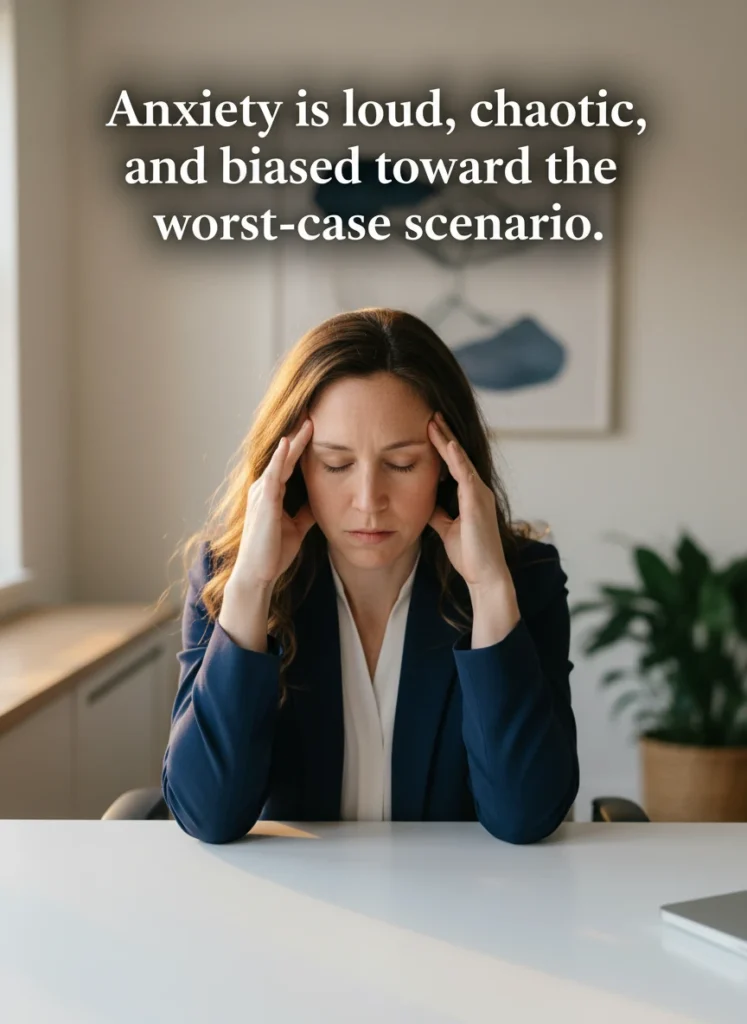
Your brain starts screaming, “Danger!” even when you are perfectly safe sitting on your living room couch. According to neuroscientists, this fight-or-flight response is designed to keep you alive, not to help you make nuanced, aligned life choices. It is loud, chaotic, and heavily biased toward predicting the worst-case scenario.
The Source of Intuition: The Enteric Nervous System
Intuition, on the other hand, relies heavily on your “second brain.”
Science refers to this as the Enteric Nervous System (ENS). You have over 100 million neurons lining your gastrointestinal tract. This vast neural network is in constant communication with your brain via the vagus nerve.
As noted by researchers at Harvard Medical School, this gut-brain connection is incredibly powerful. Intuition is the process of your brain subconsciously rapidly matching past experiences, patterns, and subtle environmental cues, and then sending a “summary report” down to your gut.
It bypasses conscious, slow, analytical thinking. It is a highly efficient data-processing system. According to experts at Psychology Today, intuition is not magical; it is rapid, subconscious pattern recognition.
Why the Confusion Happens
The problem arises because the vagus nerve acts as a two-way street.
When you are anxious, your brain sends distress signals down to your gut, causing nausea or “butterflies.” When your intuition speaks, your gut sends signals up to your brain.
Because the pathways overlap, a traumatized or highly stressed nervous system cannot easily tell the difference. This is why mastering intuition vs anxiety requires learning a new sensory language.
The Core Sensations: Decoding Intuition vs Anxiety
To master the dynamic of intuition vs anxiety, you must become a student of your own physical sensations.
Your body is a highly tuned instrument. Right now, it is playing music, but you have forgotten how to read the sheet music. We are going to change that.
Let’s break down the distinct, qualitative differences in how these two phenomena actually feel inside your body.
How Anxiety Feels in the Body
Anxiety is a frantic, vibrating energy. It feels like a motor that is revving too high in a car that is stuck in park.
When anxiety is running the show, your body feels contracted. You might experience a shallow, fluttering sensation high up in your chest. Your throat might feel tight, as if you are trying to swallow a golf ball.
Your breath becomes jagged and sits entirely in your upper lungs. The physical sensation of anxiety is often accompanied by a sense of impending doom. It is an energy of desperation.
It feels like trying to hold a handful of water—the tighter you squeeze, the faster it escapes.
How Intuition Feels in the Body
Intuition is a completely different energetic signature. It does not buzz; it hums.
When your intuition speaks, even if it is warning you against something, the physical sensation is remarkably grounding. It feels like a heavy, solid stone dropping into a quiet pond.
You will typically feel intuition lower in your body—deep in your stomach or your pelvic floor. Even if the intuitive message is “no, do not do this,” your breathing remains relatively steady. There is no frantic buzzing.
Intuition feels expansive, clear, and oddly peaceful. It is a quiet certainty.

7 Steps to Decipher Intuition vs Anxiety in the Moment
Knowing the physical differences is only half the battle. What do you do when you are in the heat of the moment?
When the deadline is approaching, the text message is waiting for a reply, and your mind is spinning out of control?
Here is your comprehensive, step-by-step roadmap for untangling intuition vs anxiety in real-time.
Step 1: Examine the Timeline of Urgency
The most reliable way to tell the difference between these two states is to look at their relationship with time.
Anxiety demands an answer right this exact second. It is a tyrannical boss screaming that if you do not make a choice now, the world will end. It thrives on artificial urgency.
Intuition, however, is deeply patient. Your inner knowing does not care about artificial deadlines. It is content to wait because the truth does not expire.
The Test: Tell yourself, “I am not going to make a decision on this for 24 hours.” If your mind goes into a frantic tailspin of panic, that is anxiety. If you feel a wave of relief and a quiet knowing that the answer will remain the same tomorrow, that is your intuition.

Step 2: Analyze the Tone of the Inner Voice
Listen closely to the narrator inside your head. What vocabulary is it using?
Anxiety speaks the language of “What if?” It is obsessed with the future and desperate to control the uncontrollable. It strings together wild, dramatic narratives.
“What if they hate me? What if I fail and lose all my money and end up homeless?”
Intuition does not ask questions. It speaks the language of “What is.” It does not provide complex, dramatic backstories. It offers simple, declarative statements.
“This job is not right for me.” or “It is time to leave this relationship.”
If you are struggling to quiet that dramatic voice, learning to silence your inner critic is a crucial foundational step.
Step 3: Map the Somatic Sensations
As we discussed, the geography of your body holds the answers. You must practice interoception—the ability to perceive sensations inside your body.
According to research published in the National Institutes of Health (NCBI), strong interoceptive awareness is directly linked to better emotional regulation.
When the feeling hits, close your eyes. Ask yourself, “Where exactly does this live in my body?”
If the sensation is pulling you upward—into a tight throat, a racing chest, or a spinning head—anxiety is likely the culprit.
If the sensation anchors you downward—into a heavy gut, a solid stance, and a feeling of being rooted to the floor—you are tuning into your intuition.
Step 4: The “Projection vs Evidence” Test
Anxiety is a master illusionist. It takes a tiny kernel of truth and projects a massive, terrifying shadow onto the wall.
When you are caught in the intuition vs anxiety loop, you must look at the cold, hard data. Is this feeling based on actual, observable evidence in the present moment? Or is it based on a painful memory from your past?
For example, if you feel a pit in your stomach because your new partner did not text back right away, ask yourself: Is there evidence they are abandoning me?
If they have been consistently loving and reliable, your feeling is likely a trauma response from a past relationship. That is anxiety.
If you want to stop letting the brain invent evidence, you must learn to stop catastrophizing your daily experiences.
Step 5: Evaluate the Emotional Aftermath
Imagine yourself following the feeling. What is the emotional payoff?
If you obey your anxiety, the immediate result is usually a brief, fleeting sense of relief, followed quickly by guilt or more anxiety. Avoidance fuels the anxiety fire.
If you obey your intuition, the immediate result might be difficult or uncomfortable (like initiating a tough breakup), but it is followed by a profound, lasting sense of relief and liberation.
Intuition brings alignment. Anxiety brings a temporary escape.

Step 6: The Ego and Envy Check
Sometimes, we confuse our intuition with our ego’s desire to protect our social standing.
Are you avoiding a career change because your “intuition” says it is a bad idea? Or are you secretly terrified of what your peers will think if you start over?
Anxiety is deeply concerned with external validation. It cares about optics, status, and the opinions of the crowd. Intuition genuinely could not care less about what anyone else thinks.
True intuition operates entirely outside the bounds of societal expectations.
Step 7: The Micro-Action Litmus Test
When you are completely paralyzed between intuition vs anxiety, take one tiny, reversible step toward a decision.
If you are unsure whether to attend a networking event, take the micro-action of picking out your outfit and putting it on. Notice how your body responds to the physical movement toward the choice.
If your body slowly starts to relax and the dread lifts, your initial hesitation was just anxiety. If the heavy, sinking feeling of “wrongness” intensifies with every step, that is your intuition screaming to be heard.
The “Intuition vs Anxiety” Journal Spread
One of the most powerful ways to externalize this internal battle is through journaling. When thoughts are swirling in your mind, they feel massive. When you trap them on paper in black ink, they shrink to their true, manageable size.
If you regularly utilize journaling for anxiety relief, you already know how clarifying this process can be.
Here is a specific journal spread designed exclusively to untangle intuition vs anxiety.
Setting Up the Page
Grab a blank page in your journal and draw a line directly down the middle. You are going to create a “T-Chart of Truth.”
On the top left side, write: The Frantic Mind (Anxiety). On the top right side, write: The Quiet Body (Intuition).
Prompts for the Left Side (Anxiety)
Under the left column, brain-dump everything that is buzzing in your head. Do not filter yourself. Let the anxiety speak its dramatic truth.
- What is the absolute worst-case scenario my mind is inventing right now?
- What “What if?” questions are keeping me awake?
- Who am I afraid of disappointing if I make the wrong choice?
- How much of this fear is based on past trauma rather than present facts?
Prompts for the Right Side (Intuition)
Now, take a deep breath, roll your shoulders back, and place your non-dominant hand over your belly. Tune into the right column.
- If I stripped away all fear of judgment, what would I choose right now?
- What does my body physically feel when I think about Option A? Option B?
- What is the quietest, simplest truth hiding underneath all this noise?
- If a deeply loving mentor were looking at this situation, what would they say I already know?
Review the two columns. The visual difference between the frantic, lengthy paragraphs on the left and the short, simple truths on the right will stagger you.

What to Avoid When Decoding Intuition vs Anxiety
As you practice this new skill, you will encounter roadblocks.
Your brain has spent years, perhaps decades, relying on anxiety as a primary navigation tool. Rewiring this system takes time. To speed up your progress in mastering intuition vs anxiety, avoid these common pitfalls.
1. Avoid Polling the Audience
When you are anxious, your first instinct is likely to text five different friends to ask what you should do. Stop doing this.
Seeking constant external reassurance weakens your internal compass. Every time you ask someone else to interpret your gut feelings, you are telling your own intuition that you do not trust it.
Learn to sit in the discomfort of your own counsel.
2. Avoid Confusing Excitement with Anxiety
This is a incredibly common trap. Your body releases the exact same neurochemicals (adrenaline and cortisol) whether you are terrified or thrilled.
Your mind might interpret the physiological arousal of stepping out of your comfort zone as a “gut feeling that this is a bad idea.” It is not a bad idea; you are just growing.
Growth feels scary. Do not let anxiety disguise itself as an intuitive red flag just to keep you safely playing small.
3. Avoid Forcing the Answer
You cannot bully your intuition into speaking louder.
If you are obsessively meditating, journaling for hours, and crying on the floor demanding an answer from the universe, you are entirely in the realm of anxiety. Intuition cannot be forced.
It reveals itself only when the nervous system is calm enough to receive the signal. If you do not know the answer right now, your only job is to radically embrace uncertainty until clarity arrives.
Tools & Setup: Creating a Sanctuary for Intuitive Listening
You cannot hear a whisper in a crowded, noisy room. Similarly, you cannot hear your intuition if your environment and daily habits are constantly triggering your stress response.
Mastering intuition vs anxiety requires setting up an environment that signals absolute safety to your nervous system.
Curating Your Physical Space
When you sit down to journal or meditate on a difficult decision, pay attention to the sensory details of your room. Your vagus nerve is constantly scanning your environment for threats.
Dim the harsh overhead lights and use warm lamps. Bring grounding objects into your space—a heavy weighted blanket, a smooth river stone, or a warm cup of herbal tea.
The physical weight and warmth send direct signals to your brain stem that you are safe, allowing the analytical mind to rest and the intuitive mind to step forward.
Somatic Reset Techniques
Before you try to distinguish your true feelings, you must reset your nervous system out of fight-or-flight mode.
Try the physiological sigh: Take two sharp inhales through the nose, followed by one long, slow, audible exhale through the mouth. Repeat this three times.
Alternatively, use cold exposure. Splash ice-cold water on your face for thirty seconds. This triggers the mammalian dive reflex, immediately lowering your heart rate and cutting through the anxious buzzing in your head.
The Right Tools for the Mind
When journaling your way through intuition vs anxiety, the physical act of writing matters.
Use a pen that flows effortlessly across the paper. You do not want physical resistance from a scratchy pen interrupting your flow state. Use a dedicated journal—a sacred space free from to-do lists and work notes.
When your brain knows that opening this specific notebook means it is time to access deep inner truths, it will naturally begin to shift gears the moment you crack the spine.

Frequently Asked Questions About Intuition vs Anxiety
To ensure you have a complete, bulletproof understanding of this dynamic, let’s address the most common questions that arise when doing this deep inner work.
Can my intuition be wrong?
True intuition is never “wrong” in the sense that it lies to you. However, our interpretation of the intuitive signal can be flawed.
Sometimes, intuition simply tells us to pay attention, but our anxious minds immediately jump to the conclusion that something terrible is going to happen. The signal was right (pay attention), but the translation was wrong (panic).
How do I rebuild trust with my intuition after ignoring it for years?
Start incredibly small. Do not try to use your newly rediscovered intuition to make a massive life change like moving across the country.
Use it for micro-decisions. Ask your gut what it wants for breakfast. Ask your body which route it wants to drive to work. Honor those tiny nudges.
Trust is built through consistency. As you honor the small intuitive hits, your internal system will begin to trust you with the big ones.
What if my anxiety is so loud I literally feel nothing else?
If you are in a state of clinical panic or profound generalized anxiety, your primary goal is not to find your intuition. Your primary goal is nervous system regulation.
You cannot navigate a ship in a category five hurricane. Seek out grounding practices, therapy, or somatic experiencing first. Once the storm lessens, the quiet voice of intuition will still be there waiting for you.
Conclusion: Becoming the Master of Your Inner World
Learning to navigate the complex labyrinth of intuition vs anxiety is not a one-time event. It is a lifelong practice.
There will still be days when you get it wrong. There will be moments when you let fear make a decision, or when you mistake a nervous flutter for a cosmic warning. That is perfectly okay.
The goal is not perfection. The goal is connection.
Every time you pause, place a hand on your stomach, and ask yourself, “Is this frantic or is this firm?”, you are rewiring decades of conditioned panic. You are taking your power back from a world that profits off your self-doubt.
You hold all the answers you will ever need right inside your own body. You just have to be willing to sit quietly enough to listen.
Start treating your inner voice with deep respect. Learn to be your own best friend through the confusion.
The next time you face a massive crossroads, you will not need to panic. You will simply drop into your body, take a breath, and know exactly which way to walk.


