
Movement as Medicine: Building an Exercise Habit You Don’t Hate
The alarm clock blares in the pitch black of early morning.
You crack open one eye, and a familiar, heavy dread washes over you. Beside your bed sits a pair of stiff running shoes and a guilt-inducing pile of workout clothes.
Your brain immediately starts negotiating. Maybe tomorrow. I’m too tired. I have a big meeting today anyway.
You hit snooze. The guilt settles in your chest, heavy and cold.
If this scene sounds familiar, you are not lazy, unmotivated, or broken. You are simply trapped in a cycle of treating movement like a punishment rather than a privilege.
For years, diet culture and the fitness industry have sold us a toxic lie. They told us that fitness must be grueling, painful, and exhausting to “count.”
But what if there was another way? What if you could finally build an exercise habit you don’t hate?

Imagine waking up and actually craving your daily movement. Imagine slipping on your sneakers not out of obligation, but because your body is asking to stretch, move, and breathe.
This isn’t a pipe dream for the genetically blessed. It is a psychological shift that anyone can make.
In this definitive guide, we are going to dismantle everything you thought you knew about working out. We will replace the dread with a deep, intuitive connection to your physical self.
It is time to stop fighting your body. Let’s learn how to create an exercise habit you don’t hate, transforming movement into your daily medicine.
The Psychology of Dread: Why We Hate Working Out
To build an exercise habit you don’t hate, we first need to understand why you despise it so much right now.
Most people approach fitness with a completely backwards psychological framework. We use exercise as a currency to “pay off” the food we ate, or as a physical punishment for not looking a certain way.
This creates a powerful negative association in the brain. According to the principles of operant conditioning, if an action consistently leads to pain, discomfort, or feelings of inadequacy, your brain will do everything in its power to avoid it.
Your brain is incredibly efficient. It views a grueling, hour-long HIIT workout as a threat to your energy reserves.
The Trap of Decision Fatigue
Furthermore, we rely far too much on willpower. By the time you finish a long workday, you are suffering from acute decision fatigue.
Harvard Business Review notes that decision fatigue actively depletes your executive function. When your brain is exhausted from making choices all day, it will always choose the path of least resistance.
The path of least resistance is the couch. It is never the gym.
The Zeigarnik Effect and Fitness Guilt
Then, there is the Zeigarnik Effect. This psychological principle states that we remember uncompleted tasks far better than completed ones.
When you set an unrealistic goal—like working out for six days a week—and inevitably fail, that failure stays top of mind. It becomes an open loop in your psyche, whispering that you are a failure.
To overcome this, we must completely rewire your approach. We must transition from a fixed mindset to a growth mindset regarding your physical capabilities.

We need to make the barrier to entry so low that it bypasses the brain’s threat response entirely.
Here is exactly how to do it.
Step 1: Detoxifying Your Fitness Mindset for an Exercise Habit You Don’t Hate
The first step to building an exercise habit you don’t hate happens entirely in your mind.
You must formally decouple movement from weight loss, aesthetics, and calorie burning. As long as exercise is tied to altering your appearance, it will always feel like a chore.
Movement is not a tax you pay for existing. It is an investment in your mental clarity, your emotional resilience, and your physical longevity.
Psychological Context: Intrinsic vs Extrinsic Motivation
Studies published by the American Psychological Association (APA) show that extrinsic motivation (working out to look good for a vacation) is highly fragile. It fades the moment the external reward is removed or delayed.
Intrinsic motivation, however, is resilient. This means finding a reason to move that feels inherently rewarding in the moment.
You move because it clears the brain fog. You move because it helps you sleep deeply. You move because it makes you feel powerful.
What to Avoid: The Punishment Paradigm
Never use movement to “burn off” a meal. The moment you catch yourself saying, “I need to run because I ate a donut,” stop.
This language reinforces the punishment paradigm. Instead, lean into body neutrality. Focus on what your body can do, rather than how it looks while doing it.
Step 2: Discovering Your Unique “Movement Archetype”
To cultivate an exercise habit you don’t hate, you have to actually find movement that you like.
This sounds incredibly obvious, yet millions of people force themselves onto treadmills despite loathing every single second of it. If you hate running, do not run.
There is no moral superiority to lifting weights in a dusty gym over dancing in your living room. Movement is movement.

Explore the Movement Spectrum
Think of movement as a vast, colorful buffet. You have been forcing yourself to eat plain broccoli every day, completely ignoring the rest of the options.
Are you someone who needs high-energy, community-driven environments? Try a spin class or a local hiking group.
Do you crave deep, restorative quiet to calm your nervous system? Look into Yin yoga, Pilates, or slow, mindful walking.
The “Joy Filter” Exercise
Take a piece of paper and write down all the ways you used to move as a child. Did you ride a bike? Did you swim? Did you climb trees?
Childhood movement was entirely rooted in play. To build an exercise habit you don’t hate, we need to inject play back into your adult life.
Try to find at least three forms of movement that make you smile, or at least, don’t make you want to cry.
Step 3: The “Laughably Small” Starting Line for an Exercise Habit You Don’t Hate
The biggest mistake people make when building an exercise habit you don’t hate is going from zero to sixty.
You decide to get your life together on a Sunday, and by Monday, you are attempting a 90-minute boot camp. By Wednesday, you are too sore to walk. By Friday, you have quit entirely.
This is the “Boom and Bust” cycle of fitness.
The Minimum Enjoyable Dose
Instead, I want you to find your Minimum Enjoyable Dose. This is the smallest amount of movement you can do that feels good, with zero dread attached.
For the first two weeks, your goal is not to get fit. Your goal is simply to establish the identity of someone who moves.
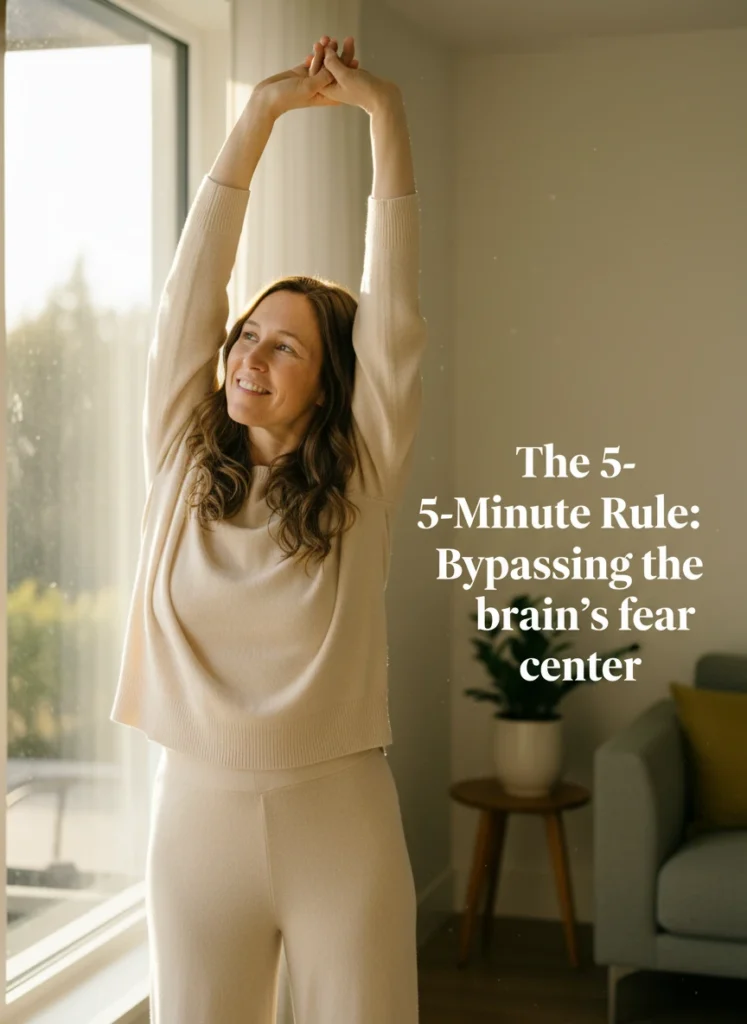
Commit to just five minutes a day. Yes, five minutes.
Bypassing the Amygdala
When you set a goal of five minutes, your amygdala (the brain’s fear center) doesn’t sound the alarm. Five minutes is easy. Five minutes is non-threatening.
You can stretch on your living room rug for five minutes. You can walk around the block once.
Often, once you start, momentum takes over and you end up doing twenty minutes. But even if you stop at five, you have successfully reinforced the habit loop.
Step 4: Mastering Friction Reduction and Habit Stacking
If you want an exercise habit you don’t hate, you must design an environment where working out is the easiest, most logical choice.
Willpower is a finite resource. Do not rely on it. Instead, rely on environmental design and habit stacking.
Habit stacking is the process of attaching a new, desired behavior to an existing, ingrained habit.
The Formula for Habit Stacking
The formula is simple: After I [CURRENT HABIT], I will [NEW MOVEMENT HABIT].
“After I pour my morning coffee, I will do ten squats while it brews.”
“After I log off my computer for the day, I will immediately put on my walking shoes.”
By anchoring the new behavior to an old one, you remove the need to “decide” when to work out. The trigger is already built into your day.
Clearing the Path
Next, relentlessly reduce friction. Friction is any obstacle—physical or mental—that stands between you and your workout.
If your workout clothes are buried in a drawer, that is friction. If you have to drive twenty minutes in traffic to reach the gym, that is massive friction.
Lay out your clothes the night before. Keep a yoga mat unrolled in your bedroom. Make the good habit undeniably easy.
Step 5: Implementing the Two-Day Rule for an Exercise Habit You Don’t Hate
Perfectionism is the enemy of consistency.
Many people believe that if they miss one workout, the entire week is ruined. This “all or nothing” mentality is exactly why you struggle to maintain an exercise habit you don’t hate.
Enter the Two-Day Rule.
The Psychology of Forgiveness
The Two-Day Rule is simple: You are allowed to miss one day of movement, but you are never allowed to miss two days in a row.
Missing one day is a bump in the road. Missing two days is the start of a new, sedentary habit.
This rule provides immense psychological relief. If you are sick, exhausted, or just having a terrible Tuesday, you can skip your workout completely guilt-free.

What to Avoid: The Compensation Trap
When you do miss a day, do not try to “make up for it” the next day by doing double the workout.
This instantly turns movement back into a punishment. Simply pick up where you left off.
Consistency is not about never failing; it is about reducing the time between failures.
Step 6: Shifting from Motivation to Discipline (Without the Suffering)
We have established that motivation is fleeting. To sustain an exercise habit you don’t hate, you will eventually need discipline.
But discipline has a PR problem. We view it as a harsh, rigid drill sergeant screaming in our ears.
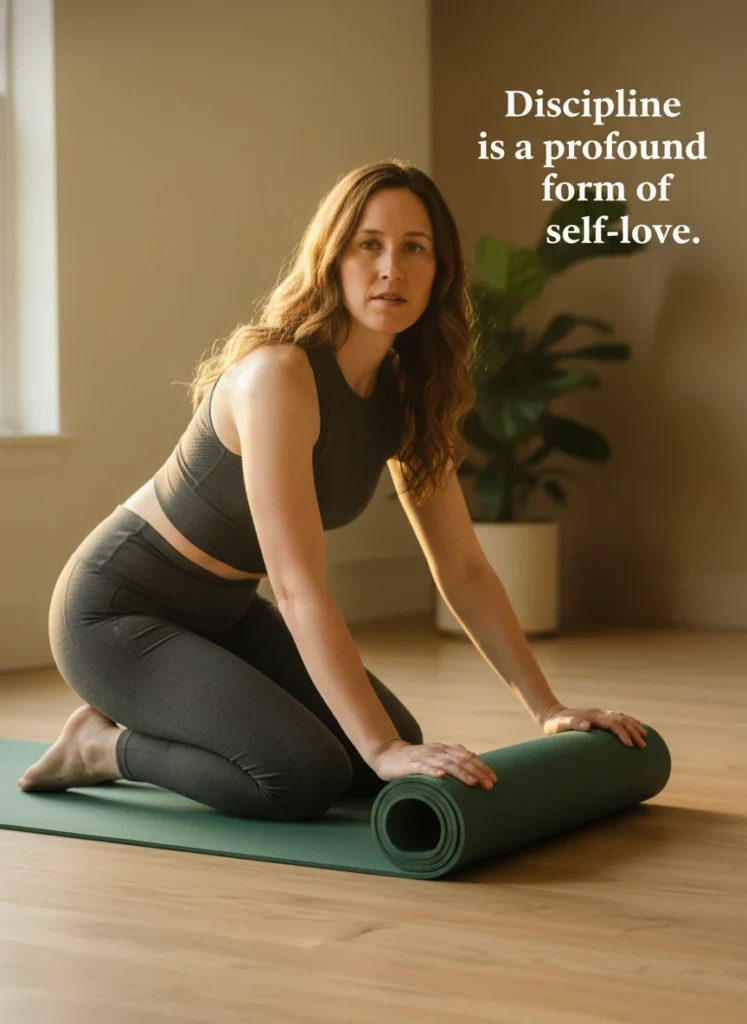
True discipline is actually a profound form of self-love. It is honoring the promises you make to yourself.
Redefining Discipline
When you understand the difference between motivation vs discipline, everything shifts. Motivation is waiting to feel like doing something. Discipline is doing it regardless of your feelings, because your future self deserves the results.
But here is the secret to an exercise habit you don’t hate: your disciplined action doesn’t have to be brutal.
If you scheduled a heavy weightlifting session but you woke up exhausted, discipline does not mean forcing yourself to lift heavy.
Discipline means keeping the appointment with yourself, but modifying the activity. You might swap the weights for a gentle 20-minute stretching routine. You kept the habit alive without punishing your body.
Step 7: Gamification and the Dopamine Loop
To cement an exercise habit you don’t hate, we need to hijack your brain’s reward circuitry.
We need to trigger the release of dopamine—the “feel-good” neurotransmitter—immediately after you move.
According to research published by PubMed regarding habit formation, immediate positive reinforcement is crucial for solidifying a new neural pathway.
The “Temptation Bundling” Strategy
Temptation bundling involves pairing a “want-to-do” activity with a “should-do” activity.
Only allow yourself to listen to your favorite true crime podcast while you are walking. Only let yourself watch that trashy reality show while you are on the stationary bike.
Suddenly, you are actually looking forward to the workout, because it is the only time you get access to your guilty pleasure.
The Power of Visual Tracking
Never underestimate the satisfaction of a visual win.
Use a physical habit tracker to check off your movement days. The simple act of marking an ‘X’ on a calendar provides a micro-hit of dopamine that reinforces the behavior.
Habit tracking takes the subjective emotion out of your progress and replaces it with objective data.
Step 8: The “Movement Menu” Journal Spread
To truly customize this process, we are going to create a visual tool in your journal.
We call this the “Movement Menu.” It is the ultimate tool for maintaining an exercise habit you don’t hate because it removes decision fatigue entirely.
When you feel tired, you don’t have to think. You just look at the menu and order what sounds good.
How to Create Your Movement Menu
Open your journal to a blank spread. Divide the pages into three columns based on your energy levels: “Low Energy,” “Medium Energy,” and “High Energy.”
Column 1: Low Energy (The “Bare Minimum” Days)
- 10-minute restorative yoga in pajamas.
- A slow, 15-minute walk around the block listening to an audiobook.
- Deep foam rolling while watching TV.
- Psychological Note: These are for days you are exhausted. Zero guilt allowed.
Column 2: Medium Energy (The Standard Days)
- 30-minute brisk walk or light jog.
- 20-minute dumbbell home workout.
- Pilates flow video on YouTube.
- Psychological Note: This is your bread and butter. It elevates the heart rate but doesn’t destroy you.
Column 3: High Energy (The “Let’s Go” Days)
- Heavy strength training session at the gym.
- A long, challenging hike.
- A high-intensity dance or spin class.
- Psychological Note: For days you want to sweat, push your limits, and feel the burn.
By having this menu pre-written, you are honoring your body’s daily fluctuations. You are no longer forcing a “High Energy” workout onto a “Low Energy” body.

Curating Your Environment for an Exercise Habit You Don’t Hate
The final piece of the puzzle is the physical setup. The tools and atmosphere you use matter immensely.
If your workout clothes are scratchy, tight, and make you feel self-conscious, you will avoid putting them on.
Invest in movement clothing that genuinely feels like a second skin. It doesn’t need to be expensive; it just needs to be comfortable. When you put it on, it should signal to your brain: We are shifting into movement mode.
Setting the Sensory Scene
Engage your senses to make the experience genuinely enjoyable.
If you are working out at home, dim the harsh overhead lights. Light a candle or turn on a warm lamp if you are doing yoga.
Create specific playlists for specific moods. Have a moody, lo-fi playlist for your slow walks, and an upbeat, nostalgic 2000s pop playlist for your strength days.
The goal is to make the environment so pleasant that the movement feels like a byproduct of a great experience.
The Post-Movement Ritual
How you finish your workout is just as important as how you start.
Create a luxurious post-movement ritual. Drink a glass of ice-cold fruit-infused water. Take a hot shower using your favorite, expensive body wash.
This signals to your brain that the workout is complete, and it ends the experience on a high, deeply rewarding note.
Your Next Steps Toward an Exercise Habit You Don’t Hate
Building an exercise habit you don’t hate is not a matter of willpower, genetics, or luck.
It is an act of deep, radical self-compassion. It is looking at the fitness industry’s punishing narrative, shaking your head, and choosing to walk your own path.
You do not have to earn your food. You do not have to punish your body for taking up space.
You simply get to move. You get to stretch your limbs, feel your heart beat in your chest, and experience the miracle of a functioning human body.
Start today. Not tomorrow, not on Monday. Today.
Pick one tiny, laughably small movement from your “Low Energy” menu. Do it for five minutes. Breathe deeply. Notice how it feels to move without judgment.
As you continue this journey, remember to be your own best friend through the process. Speak to yourself with kindness when you falter, and celebrate wildly when you succeed.
Movement is your medicine. It is time to take your daily dose.
If you found this guide helpful, grab your journal and map out your Movement Menu tonight. The path to a better relationship with your body starts with a single, gentle step.


