

A fixed mindset treats ability as mostly settled: “I am either good at this or I am not.” A growth mindset treats ability as something that can develop with learning, practice, useful feedback, and support. These are ways of interpreting a situation, not permanent personality types. The same person may feel open to learning at work and discouraged about a different skill.
The idea can help you choose a next step after a setback. It cannot guarantee success, make every goal realistic, or explain away missing time, instruction, health, money, access, or support. This guide separates the useful part of the idea from the overclaims often attached to it.

Fixed and growth mindset, in plain terms
| Situation | Fixed interpretation | Growth-oriented question |
|---|---|---|
| A first attempt goes badly | “I’m not capable.” | “What part did I not know how to do yet?” |
| Someone gives specific feedback | “They think I’m bad at this.” | “Which point is useful, and what can I ask them to clarify?” |
| Progress is slow | “I should be naturally better.” | “Is my method working? Do I need practice, instruction, time, or a different goal?” |
| A constraint blocks progress | “This proves I will never manage it.” | “What is within my control, and what support or adjustment is missing?” |
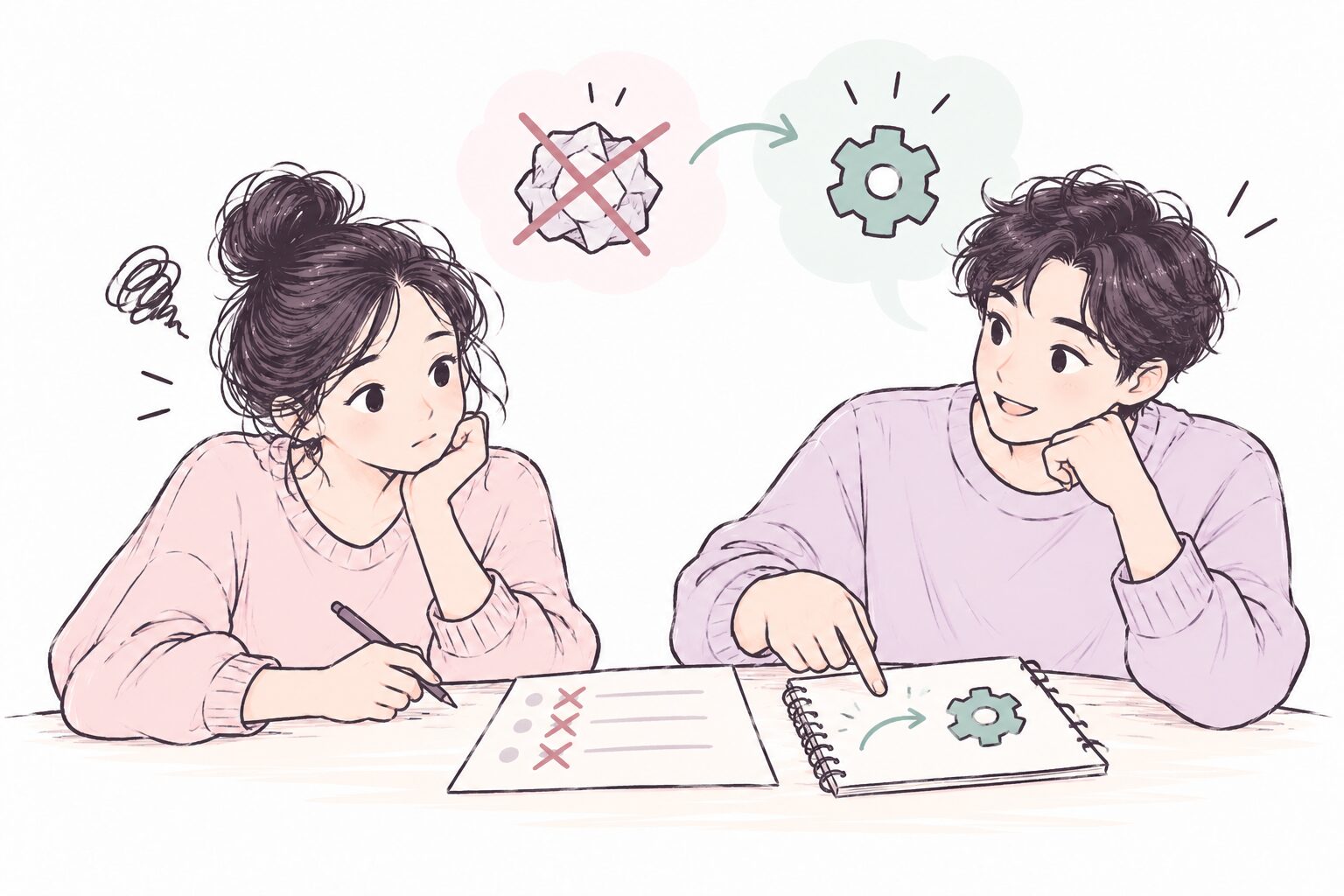
A growth-oriented response is not simply adding “yet” to every sentence. “I cannot finish this project yet” is only useful if it leads to a realistic question: What skill, information, time, or help would make the next attempt different? Sometimes the honest answer is that the goal needs to change.
A practical response to a setback
Try this short review before deciding what a difficult result means:
- Name the observable result. “I lost my place during the presentation,” rather than “I am hopeless at speaking.”
- Separate facts from guesses. Fact: two slides ran over time. Guess: everyone now thinks I am incompetent.
- Find one controllable factor. Was the outline too long, the practice too brief, or the room setup unfamiliar?
- Choose a small test. Rehearse the opening aloud once, shorten one slide, or ask a trusted colleague one focused question.
- Check the conditions. If there is no time, clear instruction, or safe chance to practise, address that constraint before blaming your attitude.
Worked example: feedback on a presentation
Feedback: “The recommendation was hard to find.”
Unhelpful conclusion: “I am bad at this job.”
Useful review: “The recommendation appeared on the final slide, after the background. I can move it to the opening, then use the later slides to explain why. I’ll ask the reviewer whether the revised order is clearer.”
This does not require pretending the feedback feels good. It turns one piece of information into a specific revision while leaving broader judgments about your worth out of the task.

What the research says—and what it does not
Growth-mindset research mainly studies beliefs about whether abilities can develop and tests interventions in educational settings. In a large U.S. study of ninth-grade students, a brief online intervention produced modest academic benefits in some groups, with outcomes depending in part on students’ prior achievement and the school context. That is evidence about a specific program and student population—not proof that a slogan will transform anyone’s life.
A 2023 systematic review and meta-analysis of 63 studies also found major differences in study quality and warned that publication and researcher bias may affect reported results. The practical takeaway is measured: beliefs can influence how someone approaches learning, but results are not uniform, and motivation alone cannot fix poor instruction or structural barriers.
Effort matters when it is paired with a workable strategy, feedback, and the resources to practise. Repeating an ineffective method or pushing through exhaustion is not automatically growth. Rest, asking for help, changing the approach, or stepping away from an unsuitable goal can be sensible choices.
A one-week learning experiment
| When | Try | Record |
|---|---|---|
| Choose one skill | Pick a small task you genuinely want or need to learn. | Why this matters and what “good enough” looks like. |
| First attempt | Try it once at a manageable scale. | What worked, what was confusing, and what support was available. |
| Get information | Review an example, ask one specific question, or find a reliable lesson. | One strategy to change on the next try. |
| Second attempt | Repeat the task with that single adjustment. | What changed; what still needs practice or support. |
| Review | Keep, revise, pause, or drop the goal. | A next step based on evidence, not self-judgment. |
The experiment is not a test of character. Its purpose is to learn whether a different strategy, clearer instruction, or more support changes the task. If nothing changes, that is useful information too.
Quick reflection prompts
- What happened that I can describe without judging myself?
- What did I try, and what did the result tell me about the method?
- What resource, feedback, time, or accommodation would help?
- Is this goal still worth pursuing under my current conditions?
Related reading
If writing helps you think, use our beginner journaling guide to try a short reflection format. For confidence built through small practice, see How to Build Confidence Through Small, Useful Practice.
Sources
- Yeager, D. S., et al. (2019). “A national experiment reveals where a growth mindset improves achievement.” Nature, 573, 364–369. Study and findings.
- Sisk, V. F., et al. (2023). “Do growth mindset interventions impact students’ academic achievement? A systematic review and meta-analysis with recommendations for best practices.” Psychological Bulletin, 149(3–4), 133–173. PubMed record.
This article is general educational information. It does not diagnose or treat mental-health conditions. See our editorial policy and disclaimer.