
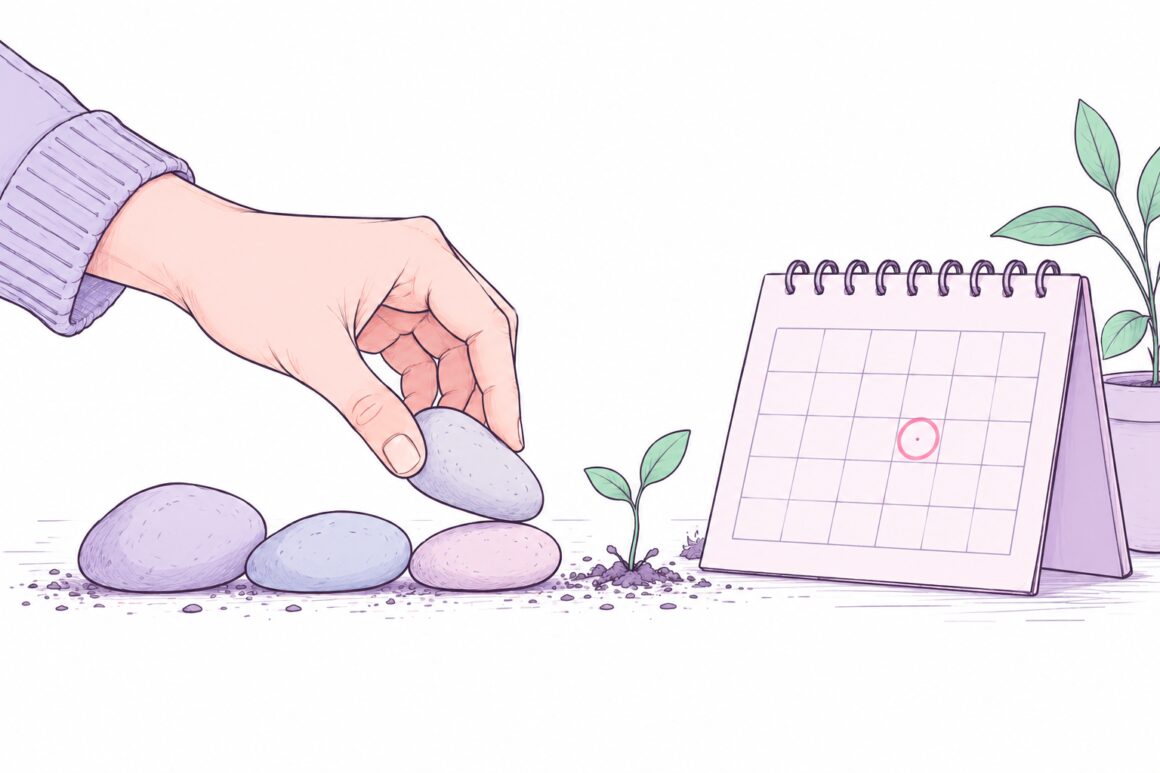
Second-guessing a choice can make even small decisions feel exhausting. Rebuilding self-trust does not mean never asking for advice or always knowing the “right” answer. It means using a decision process you can explain, then learning from what happens without treating every imperfect outcome as proof that you cannot choose.
Try the short process below for ordinary decisions. For choices about health, safety, legal matters, or major financial commitments, take the time and get qualified help the decision deserves; this article is not a substitute for that support.
A five-step decision check
| Step | Question | Write down |
|---|---|---|
| 1. Name | What decision am I making, and by when? | One sentence and a realistic deadline. |
| 2. Sort | What do I know, what am I assuming, and what is still uncertain? | Facts, assumptions, and one source to check. |
| 3. Weigh | What matters most to me here? What are the costs or trade-offs? | Two or three criteria, in plain language. |
| 4. Choose | Which option fits those criteria well enough for this situation? | A choice, a next step, and what could change it. |
| 5. Review | What did I learn once I had more information? | One lesson about the process, not a verdict on yourself. |

Match the process to the stakes
Not every choice needs a full analysis. A low-cost, reversible choice can be a small experiment. A decision that is hard to reverse or could affect your safety, health, housing, work, or finances calls for more information and support. The point is to scale the care to the consequences, not to follow a timer or make yourself decide alone.
| Decision type | Example | Useful approach |
|---|---|---|
| Low stakes and easy to change | Which notebook to use | Choose one, try it, and switch if it does not work. |
| Meaningful but adjustable | How to organize a weekly routine | Test a version for a week; note what needs changing. |
| High stakes or difficult to reverse | A medical treatment, leaving a home, signing a large contract | Check reliable information, ask qualified people, consider safety and alternatives, and allow time where possible. |
Advice can help without taking the decision away
Before asking someone, write your current view and the specific question you need answered. Pick a person with relevant experience or expertise, and tell them whether you want facts, practical help, or a second perspective. Advice is information to weigh; it does not have to become an instruction. For health decisions, NICE describes shared decision-making as a discussion of options, risks, benefits, and what matters to the person receiving care. That clinical guidance is a useful reminder to ask questions, but it is not a universal rule for every personal decision.

Worked example: a difficult work choice
Suppose you are considering whether to apply for a different role. Separate the application from the larger decision to leave: applying may give you information without committing you to accept. List what you know (the role description, pay range if published, commute), what you need to check (schedule, responsibilities, benefits), and what matters (income stability, growth, caregiving time). Then choose one next action, such as asking the recruiter about the schedule. After you learn more, decide whether the role fits. This avoids treating one uncertain feeling as a complete answer.
Review a past choice fairly
When an outcome disappoints you, do not judge the original choice only with information you learned later. Use these questions instead:
- What did I know at the time, and what could I reasonably have checked?
- Which parts of the outcome were within my control? Which were not?
- Did I follow the process I chose, or did new information change the situation?
- What would I keep or adjust the next time a similar decision comes up?
A fair review can include regret. It can also identify new information, a missed question, or a boundary you want to set. Learning does not require calling the past choice “right” or “wrong” forever.
A decision journal page
- Decision and deadline: ____________________
- What I know (and how I know it): ____________________
- What I am assuming or need to check: ____________________
- What matters most in this choice: ____________________
- Who or what could give me reliable information: ____________________
- My next step, and what could make me reconsider: ____________________
- Review date: ____________________

If you feel stuck
Shrink the next step to gathering one fact, writing one question, or asking one trusted person to listen. If no option is clearly best, note the trade-offs instead of waiting for certainty. If someone is pressuring or threatening you, prioritize safety and private support; a self-reflection exercise is not a substitute for help.
For a writing format that separates events, interpretations, and next actions, see Types of Journaling: 9 Formats and When to Use Them. For everyday habit experiments, see our friction log guide.
Source and scope
National Institute for Health and Care Excellence (NICE), About shared decision making. NICE guidance concerns decisions about health and care; we cite it only for that context.
This article provides general reflection tools. It is not medical, mental-health, legal, or financial advice. See our editorial policy and disclaimer.