
The “Do Nothing” Day: Why You Need Planned Idleness
It is 2:00 PM on a Saturday. You are sitting on the couch, staring at the wall, and your heart is quietly racing.
You are supposedly “relaxing.” Yet, a nagging, invisible weight presses down on your chest, reminding you of the laundry in the dryer, the emails you haven’t answered, and the goals you haven’t crushed. You are experiencing the modern pandemic of productivity guilt.
We live in a culture that glorifies the hustle, worshipping at the altar of crossing things off a list. But there is a silent crisis brewing inside your nervous system. You are entirely burned out, yet completely unable to rest.
This is the moment you must embrace the radical, life-altering concept of planned idleness.
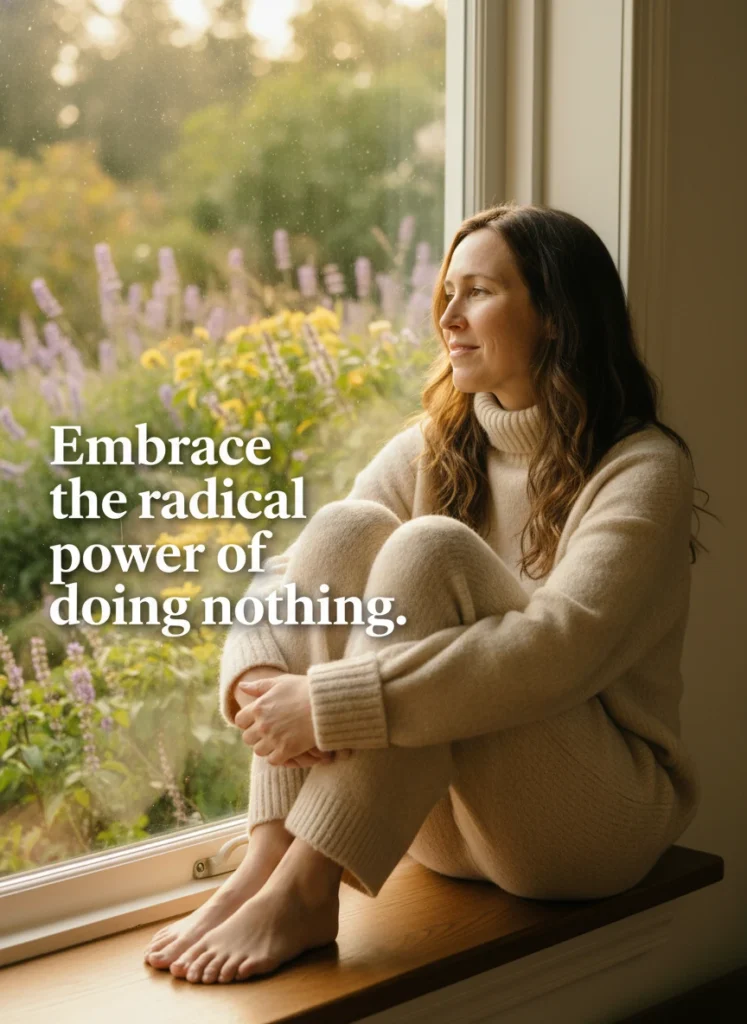
Planned idleness is not just taking a nap when you are exhausted. It is a deliberate, strategic refusal to produce, consume, or achieve for a designated period. It is the ultimate rebellion against a society that demands your constant output.
When you fail to schedule rest, your body will eventually schedule it for you in the form of sickness or severe burnout. The anxiety you feel at the end of the week isn’t a sign you didn’t do enough. It is the classic symptom of the Sunday Scaries, triggered by a lack of genuine recovery.
In this comprehensive guide, we are going to rewire how you view rest forever. You will discover exactly why planned idleness is the secret weapon of high performers. But more importantly, you will learn how to implement it without drowning in guilt.
The Psychology: Why Planned Idleness Resets Your Brain
Your brain is a biological supercomputer. But right now, you have seventy-five tabs open, music is playing from an unknown window, and the fan is screaming.
When you constantly bounce from work to podcasts to scrolling on social media, you are trapped in a state of cognitive overload. You never actually give your brain permission to power down. This constant stream of input leads to a phenomenon known as “decision fatigue.”
Every choice you make, from writing a major business proposal to choosing what to eat for lunch, depletes your psychological reserves. According to researchers at the American Psychological Association, this relentless cognitive demand is a primary driver of chronic stress and eventual burnout. You are literally wearing down the neural pathways responsible for emotional regulation.
But a magical biological process occurs when you practice planned idleness.
When you stop focusing on external tasks, your brain activates the Default Mode Network (DMN). The DMN is a specialized network of interacting brain regions that only lights up when you are daydreaming, reflecting, or doing absolutely nothing. Harvard Medical School researchers have found that the DMN is entirely responsible for our deepest moments of creativity, empathy, and problem-solving.
Have you ever noticed that your best ideas come to you in the shower? That is your Default Mode Network in action.

Furthermore, your constant need to finish tasks is driven by the Zeigarnik Effect. This psychological principle states that people remember uncompleted tasks better than completed ones. It is why your to-do list haunts you at 3:00 AM.
Planned idleness acts as a circuit breaker for the Zeigarnik Effect. By deliberately choosing to “pause” everything, you give your subconscious mind permission to stop tracking the unfinished loops. You are telling your nervous system, “We are safe right now, and nothing requires our immediate attention.”
Step 1: Redefining Planned Idleness for the Modern Mind
Most people treat rest as a reward. You tell yourself that you can only relax after the house is spotless, the inbox is at zero, and the children are asleep.
This is a fundamentally flawed paradigm. Rest is not a reward for a job well done. Rest is a biological baseline required for human functioning.
To master planned idleness, you must completely reframe your relationship with doing nothing. You must stop viewing it as “wasted time.” Instead, you must view it as highly productive recovery.
Think of an elite athlete training for the Olympics. They do not lift heavy weights every single day without a break. Their coaches mandate strict recovery days, knowing that muscles do not grow during the workout. Muscles grow during the rest period.
Your brain operates on the exact same principle. Your cognitive abilities, emotional resilience, and creativity only grow during periods of absolute stillness.

When you begin your journey into planned idleness, you will undoubtedly face resistance from your own mind. You will need to actively silence your inner critic—that loud voice telling you that your worth is tied to your productivity. You are inherently worthy, even when you are doing absolutely nothing.
Step 2: Setting Concrete Boundaries for Planned Idleness
Paradoxically, doing nothing requires rigorous planning. If you wake up on a Saturday and just loosely decide to “take it easy,” you will fail.
Without a plan, the vacuum of free time will inevitably be filled by mindless scrolling, sudden chores, or work emails. You must protect your planned idleness with ruthless aggression. It belongs on your calendar right next to your most important business meetings and doctor appointments.
Start by choosing your timeframe. If you have never done this before, do not attempt a full twenty-four hours of idleness. Your nervous system will panic.
Instead, schedule a two-hour block this coming weekend. Write it in your planner: Sunday, 10:00 AM to 12:00 PM: Planned Idleness.
Next, you must define what “nothing” means for you. This is highly subjective, but there are universal ground rules. Doing nothing means no screens, no goal-oriented tasks, no chores, and no consumption of heavy information.
You can stare at the sky. You can sit on your porch with a cup of tea. You can pet your dog.
You cannot listen to an educational podcast. You cannot organize your junk drawer. You must strictly avoid any activity that gives you a sense of “accomplishment.”

Step 3: The Pre-Idleness Brain Dump
One of the biggest obstacles to a successful “Do Nothing” day is mental clutter. You cannot force your body to relax if your mind is obsessively reviewing next week’s grocery list.
This is why the transition phase is critical. You must empty your psychological pockets before you walk through the door of relaxation.
Approximately thirty minutes before your scheduled planned idleness begins, sit down with a blank piece of paper. You are going to perform a comprehensive brain dump to declutter your mind.
Write down every single thought, task, and anxiety swirling in your head. Do not categorize them or try to solve them. Just get them out of your brain and onto the physical page.
- “I need to call the dentist.”
- “Did I send that email to Sarah?”
- “I feel guilty about missing the gym.”
Write until your mind feels completely empty. This physical act of writing transfers the burden of remembering from your brain’s short-term memory to the paper. You are essentially telling your nervous system, “The list is safe here. We do not need to worry about it right now.”
Step 4: Surviving the Productivity Withdrawal Crash
Here is a psychological truth that nobody warns you about. The first twenty minutes of planned idleness will feel awful.
You will sit in silence, and you will feel like you are crawling out of your skin. Your hands will itch for your smartphone. Your brain will flood you with a false sense of urgency, insisting that something terrible will happen if you don’t check your messages.
This is not a sign that you are failing at resting. This is a biochemical dopamine crash.
Modern technology is engineered to keep us hooked on micro-doses of dopamine. Every like, ping, and email notification triggers a tiny reward in your brain. When you suddenly cut off that supply, your brain experiences actual withdrawal symptoms.
According to addiction experts at the Mayo Clinic, smartphone dependency mimics the exact same neural pathways as chemical addictions. Your discomfort is simply your brain demanding its usual fix.
You must ride out this initial wave of anxiety. Acknowledge the physical sensation of the urge to move, but do not act on it.
Breathe deeply through the discomfort. Remind yourself that this panic is artificial. After about twenty to thirty minutes, the urge will peak and then suddenly dissipate, leaving behind a profound sense of calm.

Step 5: Mastering the Art of Digital Ghosting
You cannot practice genuine planned idleness if your smartphone is in the same room as you. The mere presence of a phone, even turned off and faced down, drains your cognitive capacity.
This phenomenon is known as the “brain drain” effect. Your brain has to actively exert energy to not check the device sitting on the coffee table.
To truly disconnect, you must physically remove the temptation. Practice a strict digital minimalism detox for the duration of your idle time.
Turn your phone completely off. Do not just put it on silent; power it down. Place it in a drawer in another room.
If you live with others, communicate your boundaries clearly before you begin. Tell your partner or family, “I am going off the grid for the next two hours. Please only interrupt me if something is on fire.”
When you remove the digital tether, you force yourself to exist entirely in the present moment. You will begin to notice the play of light on the wall. You will hear the subtle sounds of your breathing. You will finally reconnect with your own physical body.

Step 6: Cultivating Solitude in Your Planned Idleness
True planned idleness is best experienced alone. When you are around other people, you are subconsciously adapting to their moods, needs, and expectations.
Even if you are just sitting silently next to your partner, a portion of your brain is monitoring their presence. To achieve deep psychological recovery, you need absolute solitude.
Many people fear being alone with their own thoughts. We use busyness as a shield to protect us from facing our internal emotional landscape. When the noise stops, the suppressed feelings rise to the surface.
You must understand the difference between solitude vs. loneliness. Loneliness is the painful feeling of being disconnected from others. Solitude is the empowering choice to connect intimately with yourself.
During your planned idleness, if uncomfortable emotions arise, do not run from them. Do not jump up and start doing the dishes to escape the feeling.
Sit with the emotion. Observe it without judgment. Let it pass through you like a cloud moving across a clear blue sky. This emotional processing is the invisible, heavy lifting of genuine rest.
Step 7: Anchoring Your Senses in the Present
When you are stripped of your to-do lists and your digital devices, you might genuinely not know what to do with your body. The goal of planned idleness is not to become a frozen statue.
The goal is to move from a state of doing to a state of being. The easiest way to make this transition is through sensory anchoring.
Direct your full attention to your physical senses. What can you feel right now? Notice the texture of the blanket draped over your legs. Feel the weight of your body pressing into the cushions of the sofa.
What can you smell? Perhaps it is the lingering scent of morning coffee or the crisp air coming through an open window.
By hyper-focusing on raw sensory data, you bypass the analytical, planning part of your brain. You root yourself firmly in the present millisecond. This sensory grounding is a powerful way to fast-track the benefits of planned idleness.
Step 8: Redesigning Your Morning for Passive Rest
You do not have to wait for the weekend to practice planned idleness. You can weave micro-doses of doing nothing into your daily routine, starting the moment you wake up.
Most people start their day in a frantic sprint. The alarm blares, they grab their phone, read stressful news, and immediately spike their cortisol levels. This sets a chaotic, reactive tone for the next sixteen hours.
Instead, implement a low dopamine morning routine. Protect the first thirty minutes of your day as a sacred window of planned idleness.
When you wake up, do not reach for your phone. Do not immediately start planning your work agenda.
Simply lie in bed for five minutes and stare at the ceiling. Get up, make a cup of tea, and sit by a window. Watch the outside world wake up without feeling the need to interact with it.
By starting your day from a place of complete stillness, you build a fortress of calm around your nervous system. You will find that when you do finally start working, your focus is sharper, and your stress tolerance is significantly higher.

Step 9: The “Do Nothing” Journal Spread Layout
While the act of doing nothing requires no equipment, processing the experience of it is vital. Journaling after your period of planned idleness helps solidify the neurological benefits.
Create a dedicated spread in your notebook to document your journey with rest. Do not overcomplicate this layout; the irony of stressing over a rest journal is not lost on us.
Left Page: The Pre-Rest Purge
- The Brain Dump Box: A large, unlined square taking up the top half of the page. This is where you quickly scribble down all your anxieties before your idleness begins.
- The Permission Statement: Write in bold letters at the bottom: “I give myself full permission to exist without producing. My worth is not my output.”
Right Page: The Post-Rest Reflection Create three simple sections to fill out after your planned idleness is over.
- Section 1: The Resistance: What did your brain try to trick you into doing during the first 20 minutes? (e.g., “I desperately wanted to check my work email.”)
- Section 2: The Breakthrough: At what moment did you finally feel your nervous system relax? How did your body feel?
- Section 3: The Carryover: What is one feeling of calm from this session that you want to carry into your active day?
Use this layout every time you practice planned idleness. Over time, you will start to see fascinating patterns in how your mind resists, and eventually surrenders to, genuine rest.

Step 10: Gently Transitioning Out of Idleness
How you end your period of planned idleness is just as important as how you begin it. If you spend two hours in deep, restorative stillness and then immediately jump into a chaotic Zoom meeting, you will shock your nervous system.
You need a buffer zone. Think of a scuba diver returning to the surface of the ocean. They must ascend slowly to avoid getting decompression sickness. You must ascend from your planned idleness with the same deliberate care.
When your scheduled rest time is up, do not jump off the couch. Take three deep, intentional breaths.
Slowly stretch your arms and legs. Acknowledge the deep sense of peace you have cultivated. Thank your mind and body for allowing you to pause.
When you do turn your phone back on, do not immediately open your email or social media apps. Give yourself a ten-minute grace period of physical movement—perhaps walking to the kitchen for a glass of water—before you re-engage with the demands of the digital world.
Essential Tools & Setup for Planned Idleness
While doing nothing requires zero financial investment, curating the right physical environment will drastically improve your success rate. Your space acts as a psychological trigger. If you try to practice planned idleness sitting at your home office desk, your brain will subconsciously stay in “work mode.”
You need to designate a specific “rest zone” in your home. This could be a comfortable reading chair, a corner of your sofa, or even a spot on the floor with a yoga mat.
Remove all visual reminders of labor from this space. Hide the laundry baskets. Move the stack of unpaid bills to another room. Your eyes should land only on things that promote serenity.
Incorporate soft, tactile elements into your environment. A heavy weighted blanket can do wonders for a dysregulated nervous system, providing deep pressure stimulation that lowers cortisol. Have a warm, non-caffeinated beverage nearby to give your hands something comforting to hold.
Most importantly, remove all clocks from your line of sight. Watching the minutes tick by will only induce anxiety about how much “rest time” you have left. If you need to adhere to a strict schedule, set a gentle, melodic alarm on a device in the other room, and then surrender completely to the timelessness of the moment.
Closing Thoughts on Reclaiming Your Time
Embracing the “Do Nothing” day is an act of profound self-respect. In a world that constantly demands your attention, your energy, and your output, choosing planned idleness is how you take your power back.
You will stumble at first. You will feel guilty. You will accidentally check your phone and feel like a failure. Give yourself absolute grace. You are unlearning decades of toxic conditioning that tied your human value to your economic productivity.
It takes immense courage to sit in a quiet room and simply exist. But the rewards on the other side of that discomfort are life-changing.
By making planned idleness a non-negotiable part of your routine, you are protecting your peace. You will return to your work, your relationships, and your passions with a renewed sense of unshakeable clarity.
Start small. Carve out thirty minutes this weekend. Turn off the noise. Sit down. Breathe. And give yourself the greatest gift of all: the absolute freedom to do nothing.


