How to Plan Your Day Like a CEO: Time Blocking and Prioritization
You know the feeling all too well. Your alarm goes off, and before your feet even touch the floor, your mind is racing with a million conflicting priorities.
You check your phone, flooding your brain with emails, texts, and social media notifications. Instantly, you are in reactive mode. You spend the entire day putting out fires, yet when 5:00 PM rolls around, you look at your to-do list and realize you haven’t accomplished a single meaningful goal.
It feels exhausting. It feels like you are running on a treadmill that keeps speeding up, but you are getting nowhere. If you want to step off this chaotic treadmill, you must learn to plan your day like a CEO.

When you plan your day like a CEO, you stop being a victim of your circumstances and start becoming the architect of your reality. High-level executives do not wake up and hope for the best. They operate with ruthless prioritization, intentional time blocking, and unshakeable boundaries.
The good news? You do not need a corner office or a six-figure salary to master these habits. Mastering the first 60 minutes of your morning is just the beginning of this transformation.
By the time you finish reading this ultimate guide, you will have a complete, step-by-step blueprint to overhaul your schedule. You are going to discover exactly how to plan your day like a CEO, utilizing time blocking and prioritization to reclaim your focus, your energy, and your life.
The Psychology of Productivity: Why You Must Plan Your Day Like a CEO
To truly plan your day like a CEO, you first need to understand the hidden psychological forces working against you. Your brain is a magnificent machine, but it has severe limitations when it comes to processing modern, endless demands.
Why do you feel so drained by 2:00 PM, even if you have only been sitting at a desk? The answer lies in two critical psychological concepts: Decision Fatigue and the Zeigarnik Effect.
The Danger of Decision Fatigue
Every single choice you make—from what to eat for breakfast to which email to answer first—depletes a finite reservoir of mental energy. This phenomenon is known as Decision Fatigue.
According to research published by the American Psychological Association, willpower and decision-making capacity are exhaustible resources. When you wake up without a plan, you force your brain to make hundreds of micro-decisions before you even start your real work.
When you plan your day like a CEO, you eliminate these trivial choices. You pre-decide your actions, preserving your cognitive bandwidth for the high-impact tasks that actually move the needle in your life.

The Zeigarnik Effect and Cognitive Clutter
Have you ever tried to relax, but your mind kept nagging you about an unfinished task? This is the Zeigarnik Effect in action.
Discovered by psychologist Bluma Zeigarnik, this principle states that the human brain remembers uncompleted or interrupted tasks better than completed ones. A scattered, unwritten to-do list acts as open loops in your brain, causing low-grade, chronic anxiety.
As noted in the Harvard Business Review, writing down your tasks and assigning them a specific time slot signals to your brain that the task is handled. A proper brain dump closes these loops, allowing your mind to finally rest and focus.
The Method: 10 Steps to Plan Your Day Like a CEO
If you want to plan your day like a CEO, you cannot rely on generic to-do lists. You need a comprehensive system that marries time blocking with ruthless prioritization.
Here is the exact, 10-step blueprint to take back control of your time.
Step 1: The CEO Nightly Briefing
The biggest secret to planning your day like a CEO is that the planning does not actually happen in the morning. It happens the night before.
When you wait until the morning to plan, you are already dipping into your daily allowance of decision-making power. Instead, you must implement the Nightly Briefing. Take 15 minutes at the end of your workday, or before bed, to review tomorrow’s landscape.
What appointments do you have? What are the absolute non-negotiables? Mapping this out before you sleep allows your subconscious mind to process the plan overnight, meaning you wake up with immediate clarity and purpose.
Step 2: The Ultimate Brain Dump
Before you can prioritize, you must get everything out of your head. You cannot plan your day like a CEO if your mental workspace is cluttered with grocery lists, email replies, and project deadlines.
Grab a blank sheet of paper and write down every single thing you need to do, both personal and professional. Do not organize it yet. Just let the ink flow.
This process externalizes your anxiety. By seeing all your commitments on paper, they immediately become less intimidating and much easier to manage.

Step 3: Ruthless Prioritization (The Eisenhower Matrix)
Now that you have your master list, it is time to filter it. True CEOs know that being “busy” is not the same as being “productive.”
To plan your day like a CEO, run your brain dump through the Eisenhower Matrix. Divide your tasks into four categories: Urgent and Important (Do First), Important but Not Urgent (Schedule), Urgent but Not Important (Delegate), and Neither (Delete).
Your goal is to spend the majority of your time in the “Important but Not Urgent” quadrant. This is where deep, strategic work happens. This is where your long-term goals are realized before they become stressful emergencies.
Step 4: Identify Your “Frog”
With your priorities sorted, you must pinpoint your most critical task of the day. This is your “Frog.”
Mark Twain famously said that if you eat a live frog first thing in the morning, nothing worse will happen to you the rest of the day. To plan your day like a CEO, you must adopt this philosophy and eat the frog for maximum productivity.
Your frog is the task that will have the biggest positive impact on your day, or the one you are dreading the most. It requires your highest level of cognitive energy. By scheduling this task first, you guarantee a daily win, no matter what happens later.

Step 5: Implement Time Blocking Like a CEO
Now we arrive at the core strategy: Time Blocking. A traditional to-do list tells you what to do, but time blocking tells you when to do it.
To plan your day like a CEO through time blocking, you must divide your day into distinct blocks of time, assigning a specific task or category of tasks to each block. For example, instead of writing “work on presentation,” you block out 9:00 AM to 11:00 AM exclusively for that task.
During this block, nothing else exists. You are not checking email. You are not answering texts. You are giving your absolute, undivided attention to the task at hand. This transforms your calendar from a passive record into an active weapon of focus.
Step 6: Batch Your Trivial Tasks
As you plan your day like a CEO, you will notice dozens of small, irritating tasks: replying to emails, paying bills, returning phone calls. If you scatter these throughout your day, they will destroy your focus.
The solution is Task Batching. Group similar, low-focus tasks together and assign them a single time block.
For instance, you might create a “Communication Block” from 1:00 PM to 1:45 PM. During this time, you rapid-fire through all your emails and messages. When the block is over, you close the tabs and do not look at them again until your next scheduled batch. This prevents the constant context-switching that drains your energy.
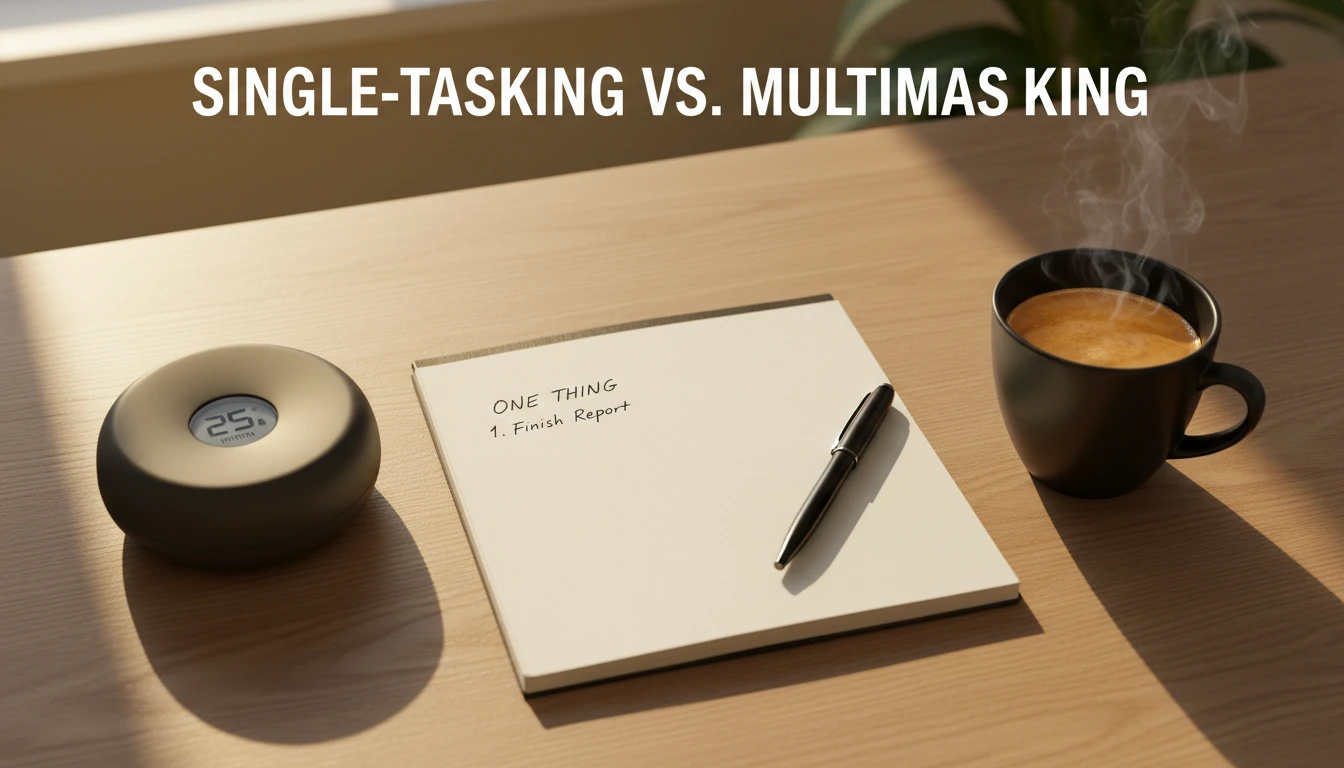
Step 7: The Power of Single-Tasking
You might think that CEOs are master multitaskers, juggling ten things at once. In reality, the exact opposite is true.
Neuroscience proves that multitasking is a myth; your brain is simply rapidly switching back and forth between tasks, losing efficiency and accuracy with every pivot. According to research from Stanford University, heavy multitaskers are actually worse at sorting out relevant information and organizing their thoughts.
When you plan your day like a CEO, you embrace the power of single-tasking. You give one task your total, unblinking focus until the time block is complete. This is the secret to producing high-quality work in half the time.

Step 8: Design White Space and Buffer Zones
A fatal flaw in most daily plans is packing the schedule from 7:00 AM to 10:00 PM with no breathing room. This is a recipe for burnout, not success.
To effectively plan your day like a CEO, you must schedule “white space.” You must build in 15 to 30-minute buffer zones between your major time blocks.
Why? Because life happens. Meetings run over. Traffic jams occur. If your schedule is too rigid, one small delay will cause your entire day to collapse like a house of cards. Buffer zones give you the grace to absorb the unexpected without derailing your focus.
Step 9: Align with Your Energy Mapping
Not all hours are created equal. Your brain has natural peaks and valleys of energy throughout the day, dictated by your circadian rhythm.
A crucial step to plan your day like a CEO is to map your tasks to your energy levels. Are you sharpest at 8:00 AM? That is when you schedule your deep, analytical work. Do you experience a slump at 3:00 PM? That is the perfect time for a low-energy task batch, like organizing files or returning routine calls.
Do not fight your biology. Work with it. For tasks that require intense concentration during your peak hours, integrating the Pomodoro Technique can keep your momentum fierce and uninterrupted.
Step 10: Cultivate Deep Work Environments
The final step in your daily methodology is protecting your blocked time at all costs. Time blocking is useless if you allow constant interruptions.
To plan your day like a CEO, you must create an environment conducive to Deep Work and supreme focus. This means putting your phone in another room or on airplane mode. This means closing all unnecessary browser tabs.
Communicate your boundaries to your colleagues or family members. Let them know that when your headphones are on, or your door is closed, you are in a focused time block and cannot be disturbed unless it is a true emergency.
The “CEO Schedule” Journal Spread
To make this actionable, you need to visualize it. You can plan your day like a CEO right inside your favorite notebook. Here is a powerful, simple journal spread you can draw right now to manage your time blocking and prioritization.
The Left Page: The Brain Dump and Prioritization
Divide the left page of your journal into two sections.
Top Half: The Brain Dump Space Leave this area open and freeform. This is where you rapid-fire write down every single thought, task, and obligation bouncing around your head. Do not edit; just write.
Bottom Half: The Top 3 Priorities Underneath your brain dump, draw three large boxes. Review the chaos of your brain dump above, run it through your mental Eisenhower Matrix, and extract the three most important tasks. Number 1 is your Frog. These are your non-negotiables. If you only accomplish these three boxes, your day is a success.
The Right Page: The Time Blocked Blueprint
The right page of your journal is your chronological map.
Draw a vertical timeline down the left margin, starting from your wake-up time to your bedtime, in 30-minute increments.
Next to the timeline, draw large boxes that span across the hours to represent your time blocks.
- Color Code Your Blocks: Use highlighters to visually categorize your day. Use Blue for Deep Work, Green for Meetings/Communication, and Yellow for Personal Care/Breaks.
- Write the Specifics: Inside each block, write exactly what task from your left page you will be tackling.
- Mark Your Buffers: Deliberately cross out or shade in 15-minute gaps between major blocks. This visual reminder ensures you actually take the breaks you scheduled to reset your mind.

Essential Tools and Setup for Executive Focus
You cannot plan your day like a CEO if your physical environment is chaotic. Your outer world reflects your inner world. To elevate your time blocking and prioritization, you need the right tools and atmosphere.
The Power of Analog Tools
While digital calendars like Google Calendar or Outlook are fantastic for scheduling meetings, there is immense psychological power in analog tools.
When you physically write out your time blocks in a high-quality journal, you are making a micro-commitment to yourself. The tactile sensation of crossing off a completed task releases a hit of dopamine that a digital checklist simply cannot replicate. Invest in a premium, lay-flat notebook and a pen that you genuinely love using. Make the act of planning a luxurious, mindful ritual rather than a chore.
Designing Your Sensory Environment
To plan your day like a CEO and execute on it, you must control the sensory inputs around you. Your environment should trigger your brain to enter a state of flow.
Consider the lighting. Natural light boosts mood and alertness, as proven by studies from the National Institutes of Health. Position your desk near a window if possible.
Consider your auditory environment. If you work in a noisy office or a busy home, noise-canceling headphones are not a luxury; they are a necessity. Create a specific instrumental playlist that you only listen to when it is time to do deep work. Over time, your brain will associate those specific sounds with intense focus, making it easier to drop into the zone on command.
The Clean Desk Protocol
At the end of every single day, clear your workspace.
Leaving papers, coffee mugs, and sticky notes scattered across your desk guarantees you will start tomorrow morning with a sense of overwhelm. A clear desk equals a clear mind. Make it a non-negotiable part of your evening routine to wipe down your surface and neatly place your journal and pen exactly where you need them for the next morning.

Common Pitfalls: What to Avoid When Time Blocking
As you begin to plan your day like a CEO, you will inevitably hit some roadblocks. Time blocking is a skill, and like any skill, it takes practice. Here are the common mistakes you must avoid to ensure your new system doesn’t collapse.
Pitfall 1: Underestimating Task Duration
The most common mistake beginners make is the Planning Fallacy. We are notoriously bad at guessing how long a task will take.
You might block off 30 minutes to write a report that actually takes two hours. When your block ends and you are not finished, frustration sets in, and you abandon the entire schedule.
The Fix: For the first two weeks, multiply your time estimates by 1.5. If you think a task will take one hour, block out an hour and a half. It is always better to finish early and gain extra white space than to run late and stress yourself out.
Pitfall 2: Being Too Rigid
You must plan your day like a CEO, but you must not act like a robot.
Some days, an emergency will completely blow up your beautiful time-blocked schedule. A client will call with an urgent crisis. A child will get sick at school. If your schedule is too rigid, you will feel like a failure.
The Fix: View your time blocks as a compass, not a cage. They show you the direction you should be heading, but you must be willing to reroute when necessary. If a block gets interrupted, take a deep breath, adjust the remaining blocks, and move forward.
Pitfall 3: Forgetting to Schedule Rest
Many ambitious women use time blocking to squeeze every ounce of productivity out of their day, scheduling back-to-back work from dawn until dusk. This is a massive mistake.
CEOs know that their energy is their most valuable asset. If you do not schedule rest, your body will eventually schedule it for you in the form of burnout or illness.
The Fix: Time block your downtime just as fiercely as your work time. Block out time for lunch away from your desk. Block out time for a 20-minute walk. Block out time to literally do nothing. Treat these rest blocks with the same level of respect you would give a meeting with your highest-paying client.

Maintaining the Momentum: The Weekly Review
Planning your day like a CEO is a powerful daily habit, but to sustain this level of prioritization, you must zoom out once a week. You need a higher-level perspective to ensure your daily actions are actually aligning with your long-term goals.
This is where the Weekly Review comes in.
Choose a specific time each week—Friday afternoon or Sunday evening work best—to sit down with your calendar and your journal. Ask yourself the hard questions:
- What worked well this week?
- Which time blocks did I consistently ignore or fail to complete?
- Where was my estimation of time completely inaccurate?
- What is the most important goal for the upcoming week?
By analyzing your past week, you gather critical data about your own work habits. You stop guessing and start optimizing. This weekly reflection is the perfect addition to a larger Sunday reset routine to prepare you for the week ahead.
Embrace the CEO Mindset Every Single Day
Learning how to plan your day like a CEO using time blocking and prioritization is not just a productivity hack. It is a fundamental shift in how you view yourself and your time.
When you stop letting your inbox dictate your actions, you reclaim your personal power. You step out of the reactive, scattered energy of the masses and step into the calm, intentional energy of a leader.
Yes, it requires discipline. Yes, it requires you to set firm boundaries with others and with yourself. But the reward is immense. You will end your days feeling satisfied rather than drained. You will make actual, tangible progress on your biggest dreams.
So tonight, before your head hits the pillow, grab your journal. Do your brain dump. Find your frog. Draw out your time blocks.
Tomorrow morning, you won’t wake up feeling overwhelmed. You will wake up ready to execute. You will plan your day like a CEO, and in doing so, you will finally take back control of your life.