Why “Faking It ‘Til You Make It” Doesn’t Work (And What to Do Instead)
We have all heard the advice. It is perhaps the most pervasive cliché in the world of self-help and career development: fake it ’til you make it. It’s written on coffee mugs, shouted by motivational speakers, and whispered by well-meaning friends when you are terrified before a big presentation.
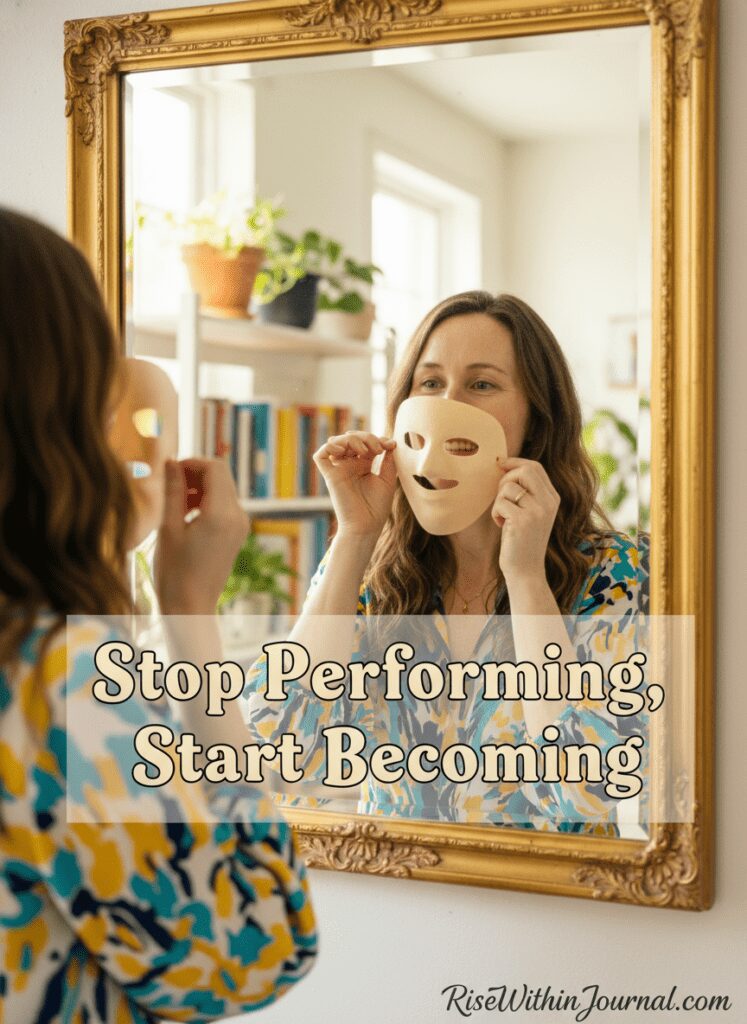
The premise sounds seductive, doesn’t it? Just put on a mask. Pretend you are the person you want to be. Act like you have the confidence of a CEO or the social ease of a celebrity, and eventually, the mask will become your face.
But here is the reality that few people talk about: for many of us, trying to fake it ’til you make it feels less like empowerment and more like lying. It feels exhaustive. It feels like wearing a costume that is two sizes too small.
Instead of building confidence, this strategy often fuels the flames of imposter syndrome at work. You spend your energy managing the perception of others rather than actually growing your skills. You live in constant fear of being “found out.” The gap between who you are and who you are pretending to be creates a low-level hum of anxiety that never quite goes away.
If you are tired of performing and ready to start actually becoming, you are in the right place. There is a better, more scientifically grounded way to build self-belief. It isn’t about deception; it’s about embodied practice. Let’s dismantle the myth of faking it and replace it with something unshakeable.
The Psychology: Why “Faking It ‘Til You Make It” Backfires
To understand why this advice fails, we have to look at how the human brain processes consistency and identity. When you attempt to fake it ’til you make it, you are essentially asking your brain to hold two opposing truths simultaneously:
- “I am terrified and feel unqualified.”
- “I am acting as if I am fearless and an expert.”
The Cognitive Dissonance Trap
In psychology, this clash is known as Cognitive Dissonance. According to the American Psychological Association, this state creates psychological stress because your actions do not align with your beliefs. When you force yourself to act confident while internally screaming with insecurity, your brain registers this as a threat.
Instead of feeling confident, you feel hyper-vigilant. Your nervous system stays in a state of fight-or-flight because it is protecting a secret. You aren’t focusing on the task at hand; you are focusing on maintaining the charade.
The Feedback Loop of Fraudulence
Research suggests that while “power posing” or acting confident can provide a momentary boost, it rarely leads to lasting change if it lacks a foundation of competence or self-compassion. In fact, relying solely on faking it can reinforce the belief that the real you isn’t enough.
Every time you succeed while “faking it,” you attribute that success to the mask, not your own ability. You think, “I fooled them again.” This prevents you from internalizing your wins and perpetuates the cycle of low self-worth. To truly silence your inner critic, we must move from performance to alignment.

From Faking to Becoming: The “Embodied Action” Method
If we aren’t going to fake it ’til you make it, what do we do? We shift the paradigm to “Embodied Action.”
This is not about pretending to be someone else. It is about identifying the traits that are already dormant within you and practicing them with intention. It is the difference between wearing a costume and working out a muscle. One covers you up; the other makes you stronger.
Here is your comprehensive, step-by-step guide to replacing the exhausting “fake it” mentality with authentic growth.
1. Reframe “Acting” as “Practicing”
The biggest problem with the phrase “fake it ’til you make it” is the word fake. It implies deception. It suggests that the behavior you are modeling is a lie.
We need to change our vocabulary. You are not faking confidence; you are practicing confidence.
Think about learning a musical instrument. When a piano student plays a scale slowly and clumsily, are they “faking” being a pianist? No. They are practicing piano. They are a pianist in training.
When you speak up in a meeting despite your shaking hands, you aren’t a fraud. You are practicing the skill of assertiveness. This subtle mindset shift reduces the shame associated with the learning curve. You are allowed to be a beginner. You are allowed to be a work in progress.

2. Bridge the Gap with “Future Self” Alignment
Faking it requires you to look at others and mimic them. Embodied Action requires you to look at your future self and align with her.
Instead of asking, “What would a confident person do?”, ask yourself: “What would the version of me who has already solved this problem do?”
This utilizes a technique often used in cognitive behavioral therapy and high-performance coaching. You aren’t copying a stranger; you are pulling on the resources of your own potential.
- Action Step: Engage in future self journaling. Visualize the version of you six months from now.
- How does she sit?
- How does she handle a mistake?
- Does she rush her words, or does she pause?
- When you walk into a room, imagine you are stepping into her shoes, not a stranger’s.

3. Embrace the Confidence-Competence Loop
One of the dangers of the “fake it ’til you make it” ethos is that it prioritizes charisma over capability. It encourages people to bluff their way through situations they don’t understand. This is a recipe for anxiety.
True confidence is earned through competence. This is known as the Confidence-Competence Loop.
- Competence: You take a small action and learn a skill.
- Confidence: You see proof that you can learn, which gives you the confidence to try the next thing.
If you feel like a fraud, check your skills. Do you actually know what you are doing? If not, the answer isn’t to fake it harder; it’s to study. It is okay to say, “I don’t know the answer to that yet, but I will find out.” That is actually a highly confident statement because it shows you aren’t afraid of the truth.
4. Replace Bravado with Vulnerability
The old school of thought tells us that confidence means being bulletproof. Never show weakness. Never admit fear.
However, modern psychological research, popularized by thought leaders like Dr. Brené Brown, shows us that vulnerability is actually the ultimate measurement of courage. Trying to fake it ’til you make it usually involves hiding your vulnerability.
Authentic confidence looks like:
- Admitting when you are overwhelmed.
- Asking for help when you are stuck.
- Owning a mistake immediately rather than covering it up.
When you embrace the idea that vulnerability is confidence, you no longer have to waste energy hiding your flaws. You can just be a human being who is doing their best. This releases the pressure valve instantly.

5. Regulate Your Nervous System (Body Language from the Inside Out)
Often, when people try to fake it ’til you make it, they adopt aggressive body language—puffing up the chest, forcing eye contact, or speaking loudly. If your nervous system is in a panic, this feels disjointed and jarring.
Instead of forcing “power poses” to trick others, use body language to signal safety to yourself.
- Grounding: Feel your feet flat on the floor. This signals to your brain that you are supported.
- Breathing: When we are “faking,” we often hold our breath. Deep, slow exhalations stimulate the vagus nerve and calm the fight-or-flight response.
- Posture: Open your chest not to dominate, but to allow room for your lungs to expand.
Read more about the nuance of posture and body language for confidence to understand the difference between aggressive posturing and grounded presence.
6. Treat Failure as Data, Not Exposure
The terrified “faker” views failure as the moment the curtain falls and everyone sees the wizard is a fraud. Because their confidence is a facade, a crack in the facade ruins everything.
The “practitioner” views failure as data.
If you are practicing a new language and you conjugate a verb wrong, are you a liar? No. You just need to correct the verb. When you stop faking it ’til you make it and start treating life as a laboratory, failure loses its sting.
- Reframing: Did a presentation go poorly? It’s not because you are an imposter. It’s because the structure of the talk needs work, or you didn’t sleep well, or the tech failed.
- Analysis: Strip the emotion away and look at the mechanics. This is key to reframing failure as data.
7. The Micro-Bravery Method
Faking it often demands huge leaps. “Walk into the boardroom and own it!”
If you have social anxiety or low self-worth, that is too big a jump. We need to bridge the gap with Micro-Bravery.
Do not try to be the most confident person in the room tomorrow. Try to be 1% more visible than you were yesterday.
- Day 1: Ask one question in a meeting.
- Day 2: Send the email you’ve been putting off.
- Day 3: Wear the outfit you love but worry is “too much.”
These small actions build a resume of bravery. You aren’t faking it; you are slowly expanding your comfort zone. This helps specifically with things like the fear of judgment.

8. Stop Outsourcing Your Self-Worth
The desire to fake it ’til you make it is almost always rooted in a craving for external validation. We want them to clap. We want them to hire us. We want them to think we are smart.
When your self-worth is tied to their reaction, you will always feel like you are performing.
We must pivot to internal validation.
- Did I think I did a good job?
- Did I act according to my values?
- Did I prepare enough?
When you stop seeking external validation, you no longer need to fake anything. You present your work, and if it lands, great. If it doesn’t, you are still worthy.
9. Adopt a “Growth Mindset” Narrative
Dr. Carol Dweck’s research on the Growth Mindset is the antidote to the “faking it” mentality.
- Fixed Mindset: “I either have confidence or I don’t. I have to pretend I have it.”
- Growth Mindset: “Confidence is a skill I can develop over time.”
When you tell yourself the story that you are “learning to be a leader” rather than “pretending to be a leader,” the brain relaxes. It is honest. It allows for mistakes. It aligns with the psychology of confidence which states that self-efficacy comes from doing, not pretending.

Tools & Setup: The “Evidence Log” Journal Spread
To transition away from “fake it ’til you make it” and toward authentic growth, you need to track your progress. Our brains are wired with a “negativity bias,” meaning we remember our awkward moments vividly but forget our small wins.
We are going to use a specific journaling technique to counter this.
The Atmosphere
Set yourself up for honesty. This isn’t performative writing. Grab your favorite pen and a cup of tea. Find a quiet corner. We are moving from the chaotic energy of faking to the calm energy of documenting.
The “Evidence of Growth” Spread
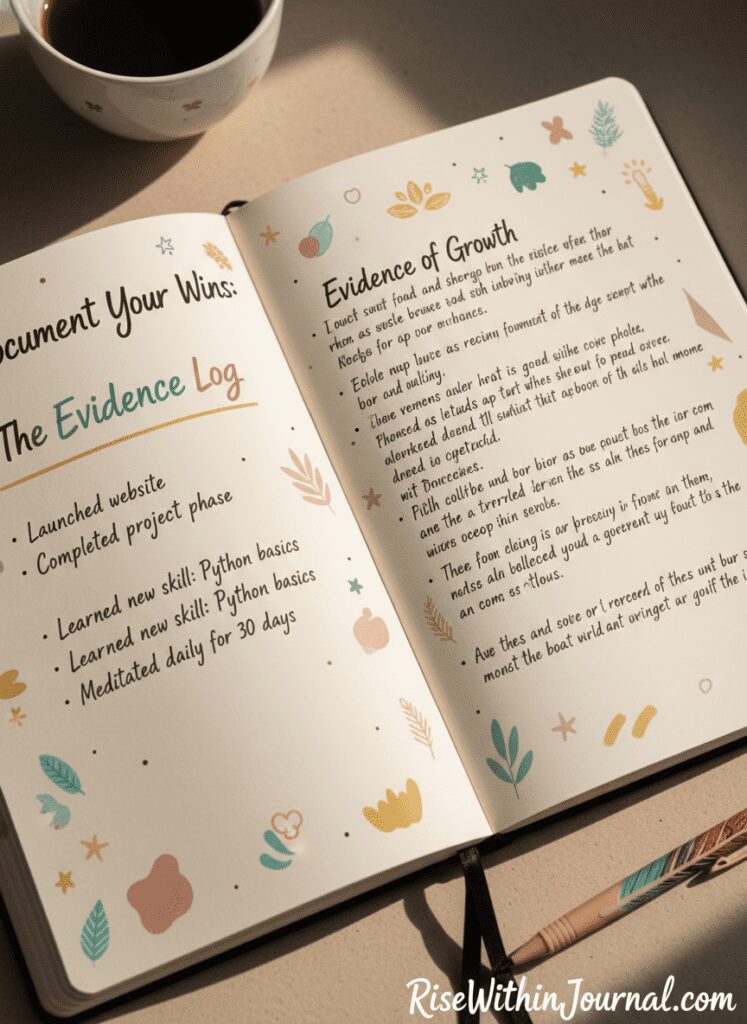
Draw a line down the middle of a page.
Left Column: The “Old Story” (The Fraud) In this column, write down the thoughts that tell you that you need to fake it.
- Example: “If I ask a question, they will know I’m not qualified.”
- Example: “I have to act extra loud or they won’t respect me.”
Right Column: The “New Evidence” (The Practitioner) In this column, write down specific evidence from the last week that proves you are capable, learning, or growing.
- Example: “I handled that difficult client call with patience.”
- Example: “I didn’t know the answer, but I researched it and followed up.”
- Example: “I felt nervous, but I spoke up anyway.”
The “Action As If” Box: At the bottom of the page, write one specific action you will take tomorrow that aligns with your Future Self.
- Example: “Tomorrow, I will speak up in meetings within the first 10 minutes.”
By documenting your competence, you build a case for yourself. You won’t need to fake it because you will have a notebook full of proof that you are making it.
Closing: You Are Enough, As You Are
The pressure to fake it ’til you make it is a symptom of a society that values image over substance. It tells us that who we are right now isn’t enough, so we must manufacture a better version to be accepted.
I want to invite you to put down the mask. It is heavy, and it is hiding the very things that make you interesting, relatable, and trustworthy.
You do not need to trick the world into respecting you. You can earn that respect through curiosity, reliability, and the courage to be a learner. You can build confidence brick by brick, action by action, until you look around one day and realize you aren’t pretending anymore. You simply are.
Start today. Not with a performance, but with a practice.
If you are ready to start documenting your journey from imposter to embodied confidence, start with our Journaling for Beginners Handbook to build the habit of self-reflection.