

A useful daily plan helps you decide what matters, when it might fit, and what can wait. It is a working draft, not a promise that the day will go exactly as expected. Start with the commitments you cannot move, choose one meaningful task, and leave some time unassigned for transitions and surprises.
This guide gives you a short planning sequence, a worked example, and a reset method for days with meetings, care responsibilities, variable energy, or interruptions. You can use a paper page, a calendar, or any notes app you already have.

Plan around capacity, not an ideal schedule
Before adding tasks, write down fixed commitments: appointments, work hours, school pickup, meals, medication reminders, or rest. Add realistic travel and transition time. The remaining open space is your available capacity; it is not all automatically productive time.
Next, make a short list of tasks that could fit. Mark deadlines and dependencies, then choose one task that would make the day feel meaningfully complete. Keep a second task as optional. If everything feels urgent, write down the actual deadline and consequence for each item before deciding; a loud notification is not always the most important task.
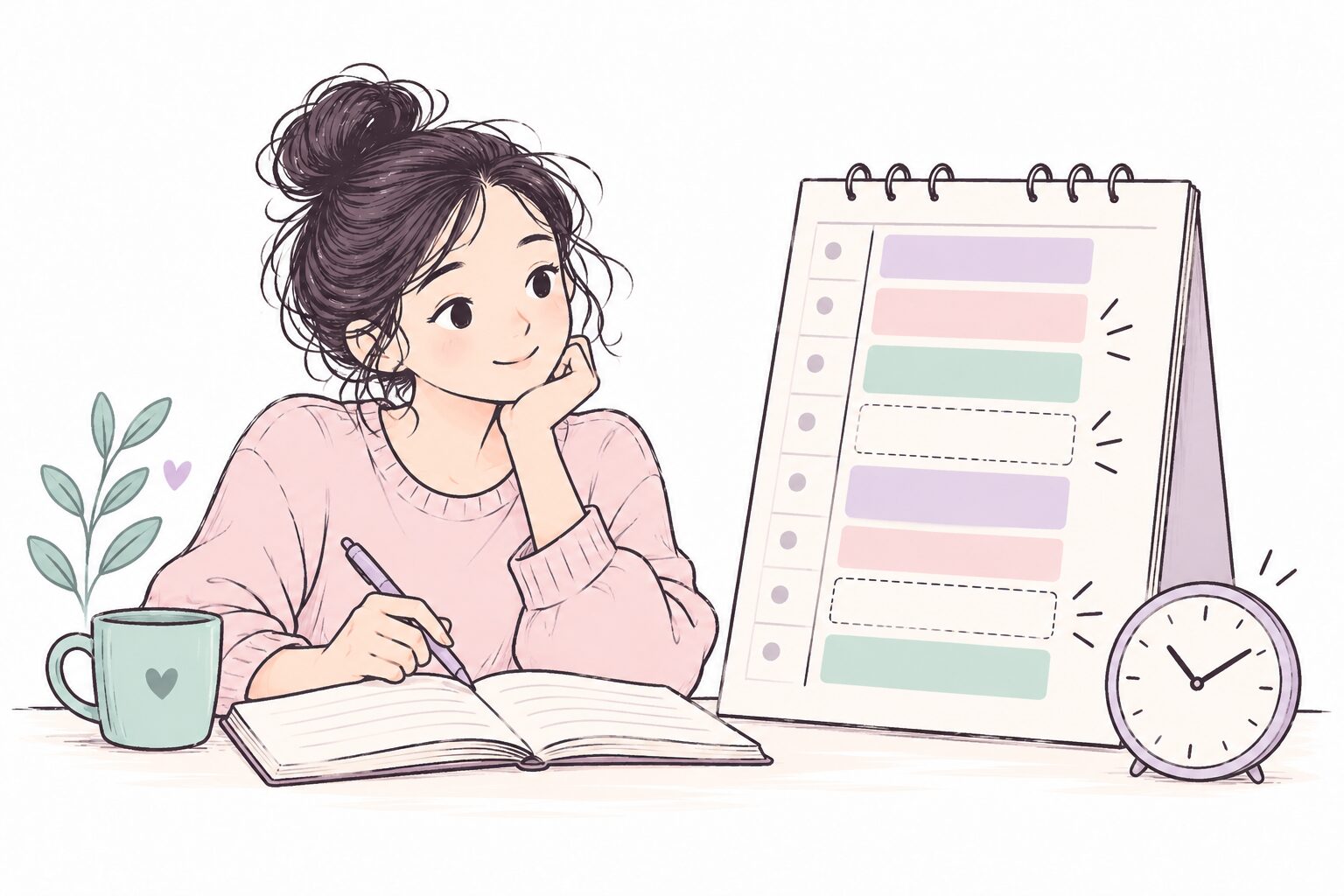
A four-step daily planning routine
- 1. Place the anchors. Add fixed commitments and the transitions around them. A 10 a.m. appointment may also require travel, preparation, and time afterward.
- 2. Choose one priority. Describe a finishable result, such as “send the revised outline” rather than “work on project.” If it is too large, write the next visible action.
- 3. Give it a realistic window. Estimate how long it might take, then leave a margin. If you have no reliable estimate, use a short first block and decide when you will review progress.
- 4. Park the rest. Put other tasks in a short later list. Decide when you will look at that list again instead of keeping every item in view all day.
For example, “After I finish breakfast, I will spend 20 minutes drafting the first section” is more actionable than “I will be productive today.” Research on implementation intentions examines whether specific if-then plans can help people move from wanting to act to starting an action. That research does not establish that one schedule works for everyone; use the wording as a planning aid and adjust it to your day.

Worked example: a day with a fixed appointment
Imagine a person who works from home, has a 10 a.m. appointment, and needs to collect a child at 3 p.m. These times are illustrative; use your actual commitments and access needs.
| Part of the day | Plan | Why it fits |
|---|---|---|
| Before 10 a.m. | Prepare for the appointment and do one 20-minute first step on the priority. | A short task fits around preparation instead of pretending the whole morning is open. |
| Late morning | Travel, appointment, and a transition afterward. | Travel and recovery time are visible rather than hidden. |
| Early afternoon | One longer work window for the same priority; stop at a chosen check-in time. | A clear stopping point makes it easier to adjust if the appointment runs late. |
| After pickup | Handle family needs and only the essential admin task, if capacity allows. | The plan acknowledges that responsibilities use real time and attention. |
Use a reset when the plan breaks
An interruption, delayed meeting, sick day, or low-energy afternoon can change the plan. Pause and ask three questions: What still has a real deadline today? What is the smallest useful next step? What can move without creating a bigger problem? Update only the remaining part of the day. Do not try to squeeze every missed task into the hours left.
If several items compete, ask the relevant person about the deadline or trade-off rather than silently promising everything. A short message such as “I can finish A today or B today; which should take priority?” can surface a decision that a calendar cannot make for you.
Make the plan fit different kinds of days
- Meeting-heavy day: Choose one task that can fit into the open window; do not count every gap as deep-work time.
- Variable schedule: Use an event as your cue—after the appointment, after lunch, or when you get home—instead of relying on a fixed clock time.
- Low-capacity day: Choose one essential task and one care task. Move optional work without judging yourself.
- Unpredictable caregiving day: Use short blocks with clear restart notes, and keep enough slack for interruptions.
A five-minute planning page
- Fixed commitments and transition time: ____________________
- One meaningful result for today: ____________________
- First action and a realistic window: ____________________
- What I will leave open as a buffer: ____________________
- Optional task if time remains: ____________________
- If the plan changes, I will first: ____________________
Keep the page short enough to use. If writing a plan becomes another source of pressure, make it smaller: list the next appointment and one next action, then begin.
Why a specific cue can help
In a 2006 meta-analysis, Gollwitzer and Sheeran reviewed 94 tests of implementation intentions: plans that connect a situation with a specific response, often phrased as “If X happens, then I will do Y.” The authors reported an overall benefit for goal attainment across those tests. That does not mean a schedule guarantees success, or that the same effect applies equally to every person, goal, or workplace. Here, a cue is simply a way to make your first action easier to identify.
Source: Gollwitzer & Sheeran, “Implementation Intentions and Goal Achievement: A Meta-analysis of Effects and Processes”, Advances in Experimental Social Psychology (2006).
Related guides
If you want a simple start-of-day cue, read our flexible morning routine. For planning a habit around an existing event, see the habit planning guide. If you prefer to close out work before the next day, try the evening wind-down guide.
This guide offers general educational planning ideas, not a promise of productivity or individualized health, workplace, or financial advice. Planning should make room for rest, access needs, and responsibilities.