

When you try to write a report while answering messages, listening for notifications, and checking a second document, it can feel as if you are doing several things at once. Most of the time, attention is switching rapidly between tasks. Each switch can make it harder to keep your place, especially when the work is unfamiliar or mentally demanding.
That does not mean every pair of activities must be separated. A routine task may fit alongside a conversation or a walk. The useful question is: which tasks can safely share attention, and which deserve a protected stretch of focus? This guide offers a practical way to decide and a small experiment you can adapt to your work.
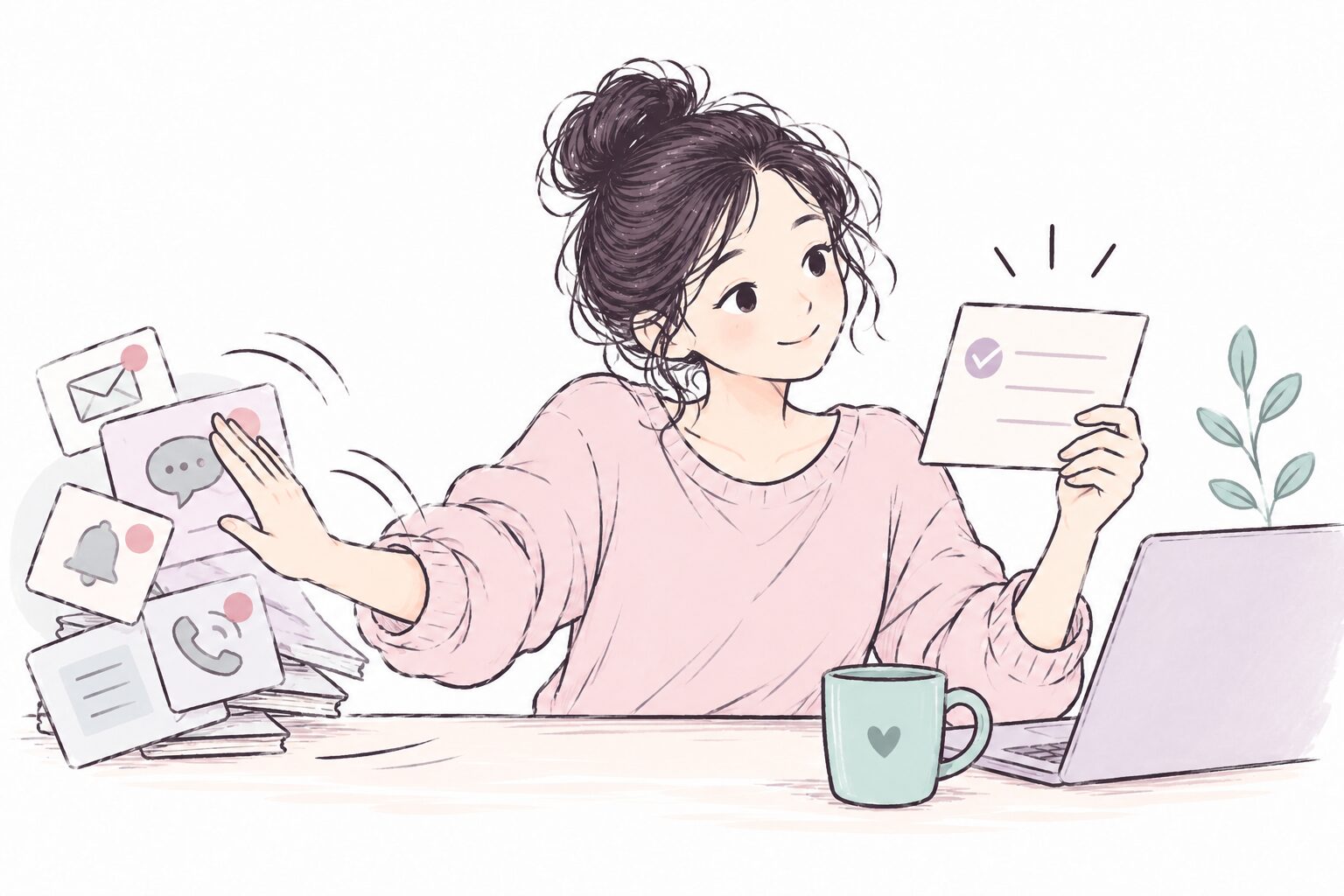
What people mean by multitasking
“Multitasking” can describe two different things. Some activities can happen together because one is familiar and requires little active thought. Other combinations rely on rapid attention switching: read a paragraph, check a message, return to the paragraph, and reconstruct what you were doing. The second pattern has a cost that can accumulate when switches are frequent.
The American Psychological Association’s overview explains that switching costs vary with the tasks and the person’s experience; a commonly repeated productivity percentage should not be treated as a universal result. In a laboratory experiment, even brief phone notifications were associated with more errors on an attention-demanding task. That finding is a reason to test notification boundaries, not proof that every alert harms everyone in every setting. Research on moving between unfinished tasks also suggests that attention can remain partly with the previous task, though the studies do not establish a fixed recovery time for all work.
Sources: American Psychological Association, “Multitasking: Switching costs”; Stothart, Mitchum & Yehnert (2015), notification experiment; Leroy (2009), attention residue experiments.

A quick decision guide
| Usually easier to combine | Usually worth separating |
|---|---|
| A familiar walk with an audio lesson | Writing a careful message while replying to chat |
| Folding laundry while talking with someone | Reviewing figures while switching between unrelated tabs |
| Waiting for a routine process while doing a simple task | Any task where a missed detail could affect safety or another person |
This is a starting point, not a rulebook. People’s jobs, access needs, caregiving responsibilities, and working environments differ. Some roles require monitoring and quick responses. If interruptions are part of the job, the aim is to make handoffs and returns clearer, not to pretend they can all be eliminated.

A practical single-tasking routine
- Choose one task for this stretch. Name the actual next action: “draft the opening section” is easier to begin than “finish the project.”
- Define a stopping point. Decide what useful progress would look like before you begin, such as outlining three points or checking one set of figures.
- Prepare the workspace for that task. Keep the needed document open. Close or move unrelated tabs if that reduces friction. Silence or batch alerts only when your responsibilities allow it.
- Pick a return point that suits the work. Try a short stretch, perhaps 20 minutes, or work to a natural stopping point. Treat the length as an experiment, not a scientifically required timer.
- When interrupted, leave a return note. Write one line: “I was checking the March totals; next compare rows 8–12; still waiting for Sam’s figure.” This note holds your place without requiring you to remember every detail.
- At the end, record the next action. If the task is unfinished, leave it in a state that makes restarting easier. Then take a break or choose the next task deliberately.
Example: finishing a short report
Suppose you need to prepare a two-page update, but messages arrive throughout the morning. Before starting, write: “Today’s useful outcome: a complete draft with the three project updates.” Open the notes and draft, and move messages out of view if you are able to check them later. Work through one section. If a colleague needs something now, respond or hand off as the role requires; before switching, jot down the sentence or section you were on. When you return, use that note to resume instead of rereading the entire document.
Try a one-week focus check
For five workdays, choose one task each day to do with fewer avoidable switches. Afterward, jot down: the task, what interrupted it, whether the return note helped, and how complete or accurate the work felt. You do not need to count every glance or turn the week into a productivity score. Look for one change that would make the next attempt easier—for example, a scheduled message check, a clearer handoff, or a smaller task definition.
Single-tasking is a tool for protecting attention when the work benefits from continuity. It is not a measure of discipline or a demand for uninterrupted days. Start with one task that matters, make the next step visible, and adjust the routine to the real constraints of your work.
Related guides
If distractions are the main obstacle, the guide to building discipline while distracted offers a practical return plan. For a routine you can repeat and revise, see the habit planning system.