Gratitude Journaling That Doesn’t Feel Repetitive or Cheesy
You are staring at a blank page, pen hovering over the paper, feeling completely empty.
You write down: “I am grateful for my family, my health, and my morning coffee.”
You close the book. You feel absolutely nothing.
If you are being deeply honest with yourself, the whole practice feels like a chore. It feels forced, uninspired, and frankly, a little bit fake.
You are not alone in this frustration. Millions of people abandon their mindfulness routines because they hit a wall of overwhelming boredom.
You have been told that a daily practice is the ultimate key to happiness. You have read the books, seen the aesthetic morning routines on social media, and bought the beautiful notebook.
Yet, your reality is just a repetitive list that reads like a grocery receipt of your life. It lacks soul.
But what if you are simply doing it wrong?
What if there is a way to approach gratitude journaling that actually shifts your brain chemistry, sparks genuine emotion, and feels profoundly deeply personal?

You are about to discover a system for gratitude journaling that doesn’t feel repetitive or cheesy. By the end of this guide, you will have a completely new framework that makes you crave your morning writing session.
If you want to master the basics first, you can always review our introductory gratitude journaling guide. But if you are ready to dig deeper and banish the boredom for good, keep reading.
The Psychology: Why Standard Gratitude Journaling Fails
Before we fix your routine, you need to understand exactly why your current method is failing you. It is not a lack of discipline. It is a psychological phenomenon.
When you write down the exact same three things every single day, your brain simply tunes them out. This is a concept known as “hedonic adaptation.”
According to research highlighted by Psychology Today, human beings are wired to quickly adapt to the good things in their lives. The thrill of a new house, a loving partner, or even your favorite coffee fades as it becomes your new normal.
When your gratitude journaling focuses exclusively on these baseline constants, your brain does not register them as new or exciting information. You are essentially asking your mind to be thrilled by the fact that the sky is still blue.
The Danger of Toxic Positivity
Another reason standard gratitude journaling feels cheesy is that it often masquerades as toxic positivity. You might feel pressured to be thankful for a job you secretly hate, just because “other people have it worse.”
This forces you to suppress your authentic feelings. When you invalidate your own struggles, your journaling becomes an exercise in self-gaslighting.
It is crucial to understand the subtle but vital difference between healthy optimism and emotional suppression. For a deeper dive into this, explore the balance of toxic positivity vs. optimism.
True gratitude journaling allows space for your shadows, your stress, and your bad days.

The Neuroscience of Meaningful Gratitude Journaling
When done correctly, gratitude journaling physically changes your brain. It is not magic; it is neuroplasticity.
Studies from Harvard Medical School demonstrate that expressing genuine gratitude activates the brain’s reward center. It releases a surge of dopamine and serotonin, the neurotransmitters responsible for happiness and calm.
But here is the catch: to trigger that chemical release, the gratitude must be felt, not just written. It requires novelty, specificity, and emotional resonance.
Standard lists do not trigger this release. To get the dopamine, you have to break the pattern.
8 Steps to Gratitude Journaling That Doesn’t Feel Repetitive
If you want to revolutionize your morning pages, you need to throw out the “list three things” rule. That rule is designed for beginners.
You need advanced techniques that force your brain out of autopilot mode. The following steps will ensure your gratitude journaling remains sharp, emotional, and deeply impactful.
Here is how you transform a boring list into a dynamic psychological tool.
Step 1: Ditch the “Big Three” for the “Micro-Specifics”
The biggest mistake you can make in gratitude journaling is going too broad. Broad statements are the enemy of emotion.
The Cheesy Way: “I am grateful for my house.” The Authentic Way: “I am grateful for the specific way the morning light hits the oak floorboards in the kitchen at 7:00 AM, creating a warm, golden rectangle where my cat likes to sleep.”
Do you feel the difference? One is a fact; the other is a cinematic moment in your life.

When engaging in gratitude journaling, challenge yourself to zoom in. Find the smallest, most granular detail of your day and magnify it.
You are training your brain to become a highly sensitive radar for tiny moments of joy. This is a brilliant way to silence your inner critic and focus on the present moment.
If you struggle with negative self-talk blocking your joy, learning how to silence your inner critic can make finding these micro-moments much easier.
Step 2: Embrace Contrast with “Mental Subtraction”
Sometimes, the best way to feel grateful is to imagine your life without the things you love. Psychologists call this “mental subtraction,” and it is incredibly powerful.
Instead of writing about what you have, write about what your life would look like if you suddenly lost it. This technique is like a shock to the system of hedonic adaptation.
The Cheesy Way: “I am grateful for my best friend.” The Authentic Way: “If I hadn’t gone to that random party five years ago, I never would have met Sarah. My life would be missing her dark humor, and I would have had to navigate my breakup completely alone.”
Mental subtraction forces you to realize that the good things in your life were not guaranteed. They are happy accidents, serendipity, or the result of hard work.
The Greater Good Science Center at UC Berkeley has shown that this specific type of gratitude journaling significantly boosts happiness levels compared to simply listing positive events.
It adds dramatic weight and emotional stakes to your entries.

Step 3: Shift from “What” to “Why” in Gratitude Journaling
Depth will always triumph over breadth. Instead of listing five things you are grateful for, list just one thing, and spend five sentences explaining exactly why.
When you list items rapidly, you are skimming the surface of your emotions. When you pause to explain the “why,” you force your brain to linger on the positive feeling.
The Cheesy Way: “I am grateful for my health, my car, and my job.” The Authentic Way: “I am deeply grateful for my car today. Not because it is fancy, but because it represents my independence. When I turn the key, it means I have the freedom to escape the city, drive to the ocean, and clear my mind whenever the stress gets too heavy.”
This method of gratitude journaling acts as an emotional anchor. It connects the physical object to your core values and inner desires.
If you are new to expanding your thoughts like this, our journaling for beginners handbook offers excellent exercises on thought-expansion.
Step 4: The “Surprise” Element of Gratitude Journaling
The brain craves novelty. To keep your gratitude journaling fresh, you must intentionally seek out the unexpected positive moments of your day.
Think back over the last 24 hours. What surprised you? What went slightly better than you anticipated?
The Cheesy Way: “I am grateful I got my work done.” The Authentic Way: “I am so grateful for the sudden rainstorm this afternoon. It gave me the perfect excuse to cancel my stressful plans, stay in my sweatpants, and read a book without a single ounce of guilt.”
Focusing on surprises trains you to look for serendipity. It disrupts the narrative that life is purely a stressful grind.
It helps you recognize that the universe occasionally hands you small, beautiful gifts when you least expect them.

Step 5: Relational Gratitude Journaling (Beyond “My Partner”)
When writing about people, it is incredibly easy to fall into repetitive ruts. You probably write “I am grateful for my spouse/kids/parents” almost every day.
To make relational gratitude journaling powerful, stop focusing on the person and start focusing on their actions.
The Cheesy Way: “I am grateful for my husband.” The Authentic Way: “I am so grateful that my husband noticed I was overwhelmed last night and quietly took over the dishes without me having to ask. It made me feel seen and supported.”
By documenting specific actions, you are building a historical record of love and kindness. On days when you feel disconnected or frustrated with your loved ones, you can look back at these specific, tangible moments.
It also prevents you from taking the people closest to you for granted.
Step 6: Gratitude Journaling for the Mundane and Annoying
This is a master-level technique. Can you find a sliver of gratitude inside an annoyance?
This is not about faking a smile when things are terrible. It is about actively reframing your perspective to reduce your own suffering.
The Cheesy Way: “I am grateful for my struggles because they make me stronger.” (Too cliché). The Authentic Way: “I am weirdly grateful for the massive traffic jam this morning. It forced me to actually slow down, and I got to listen to an entire podcast episode uninterrupted, which never happens.”
This type of gratitude journaling builds profound emotional resilience. It teaches your brain that even minor inconveniences contain hidden pockets of value.

Reframing negative situations is a core component of cognitive behavioral therapy. If you want to master this, review our guide on overcoming cognitive distortions.
Step 7: Sensory Gratitude Journaling
Get out of your head and into your body. Your five senses are the quickest gateway to the present moment.
Dedicate a session of your gratitude journaling entirely to physical sensations. What did you smell, taste, touch, hear, or see that brought you pleasure today?
The Cheesy Way: “I am grateful for good food.” The Authentic Way: “I am deeply grateful for the sharp, bitter taste of the dark chocolate I had after lunch, and the way it melted instantly on my tongue.”
Sensory journaling is incredibly grounding. According to the Mayo Clinic, engaging your senses directly lowers your heart rate and reduces cortisol (the stress hormone).
It turns your gratitude journaling into a physical relaxation exercise, not just a mental one.

Step 8: The “Future Self” Gratitude Technique
Most gratitude focuses on the past or the present. But what about the future? What about the past version of you?
Use your gratitude journaling to thank the person who is taking care of you: yourself.
The Cheesy Way: “I am grateful for my hard work.” The Authentic Way: “I am so grateful to the version of me from yesterday who decided to meal-prep. Coming home exhausted today and finding dinner already made felt like a massive hug from my past self.”
This builds immense self-trust and self-compassion. It reinforces the idea that you are your own best caretaker.
This technique often crosses over into deeper psychological territory. If you find yourself avoiding self-gratitude, you might benefit from exploring our shadow work guide to uncover why.
The “Anti-Cheesy” Gratitude Journaling Spread (Layout Guide)
Sometimes, the standard ruled lines of a notebook encourage boring, linear thinking. To break the habit, you need to change the visual layout of your gratitude journaling.
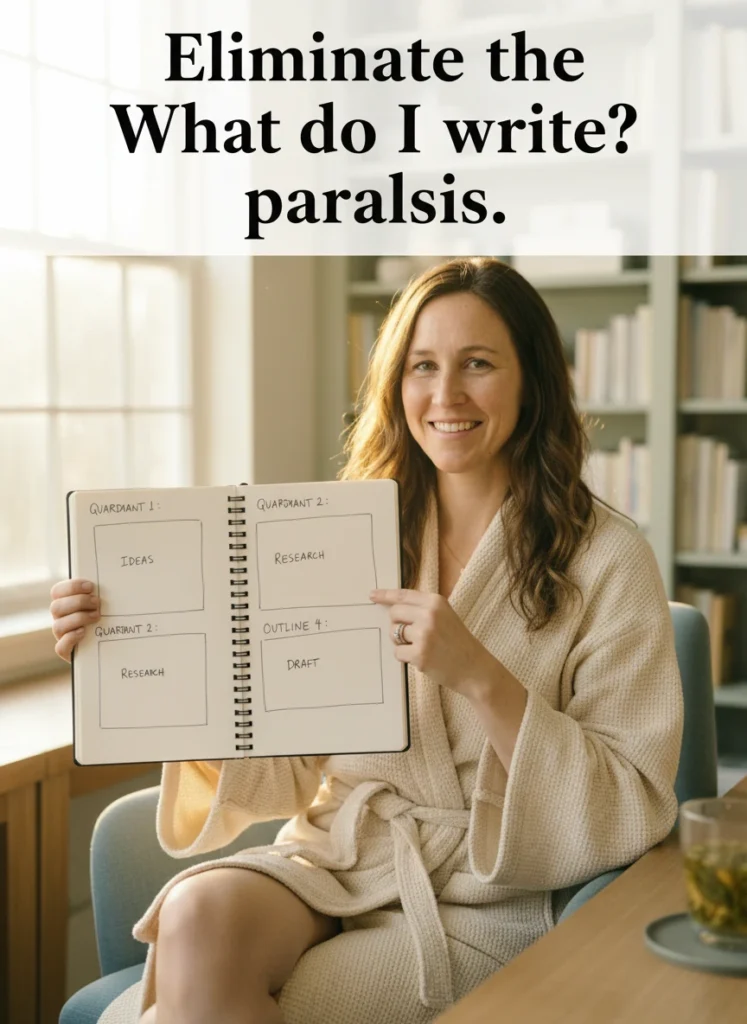
Try drawing a simple “Four Quadrant” spread in your notebook. Grab a ruler and a pen, and divide your blank page into four equal squares.
Quadrant 1: The Micro-Moment. Dedicate this box to one tiny, granular detail you noticed today. A cool breeze, a strange cloud, a perfect cup of tea. Sketch it if you feel creative.
Quadrant 2: The Mental Subtraction. Write down one thing you love, and write two sentences about how chaotic your life would be without it.
Quadrant 3: A Specific Action. Name one person, and describe exactly what they did today that made your life easier or brought you joy.
Quadrant 4: Gratitude for Myself. Write down one boundary you set, one hard task you completed, or one kind thing you did for your own body or mind today.
By compartmentalizing your gratitude journaling into these specific prompts, you completely eliminate the “What do I write?” paralysis. The boxes force you to be concise, creative, and highly specific.
It is visually satisfying and psychologically highly effective.
Tools and Atmosphere for Authentic Gratitude Journaling
You cannot expect to have a profound, emotional gratitude journaling experience if you are scribbling on a sticky note while rushing out the door. The environment dictates the depth of the experience.
You need to elevate the ritual. When you treat the practice with respect, your brain understands that this is a high-value activity.
First, consider your tools. The physical act of writing should feel pleasurable.
A scratchy, cheap pen will subconsciously irritate you and make you want to finish faster. Invest in a pen that glides effortlessly over the paper—perhaps a weighted fountain pen or a smooth, dark fineliner.
The notebook itself should lay flat. Constantly fighting the spine of a cheap notebook will pull you out of your introspective flow. Choose heavy, thick paper that absorbs ink beautifully without bleeding through.
Next, curate your atmosphere. Gratitude journaling requires sensory safety.
Dim the harsh overhead lights and turn on a warm, amber desk lamp. If your house is chaotic, put on noise-canceling headphones playing low-frequency ambient music, brown noise, or rain sounds.
Light a candle that you only burn when you journal. This creates an olfactory anchor; soon, just the smell of that specific candle will trigger a relaxed, grateful state in your mind.
Make your gratitude journaling a sacred 10-minute vacation from your life.
When you sit down, take three deep, slow breaths before you even uncap your pen. Signal to your nervous system that it is time to shift from “survival mode” to “reflection mode.”
This level of intentionality makes it impossible for the practice to feel like a tedious chore. It transforms it into a sanctuary.
If you constantly find yourself rushing this process because you are distracted by what others are doing online, it is time to address your digital habits. Stepping back from the comparison trap of scrolling is essential for maintaining the mental clarity needed for this deep work.
Final Thoughts on Meaningful Gratitude Journaling
You now possess the tools to rescue your morning routine from the depths of boredom. You do not have to settle for writing the same three meaningless sentences every single day.
Gratitude journaling is not about forcing a smile or ignoring the heavy, difficult parts of your life. It is about training your brain to become a highly skilled detective, hunting for tiny fragments of light in an otherwise chaotic world.
It is about finding the micro-specifics, thanking your past self, and deeply analyzing the “why” behind your joy.
When you implement these eight steps, your notebook will stop feeling like a dusty chore. It will become a vibrant, living record of a life truly noticed.
You will start to see the world differently. You will walk through your day subconsciously collecting beautiful, tiny moments just so you can write them down the next morning.
That is when the neuroplasticity kicks in. That is when your baseline level of happiness permanently shifts.
If you are looking for a structured way to implement some of these daily habits without building your own spreads from scratch, you might want to read our thoughts on pre-made formats like the Five Minute Journal review.
But no matter what book you use, remember this: the magic is not in the paper. The magic is in the specificity of your attention.
Grab your favorite pen, find a quiet corner, and write down the exact way your coffee smells right now. Your authentic gratitude journaling journey starts today.