
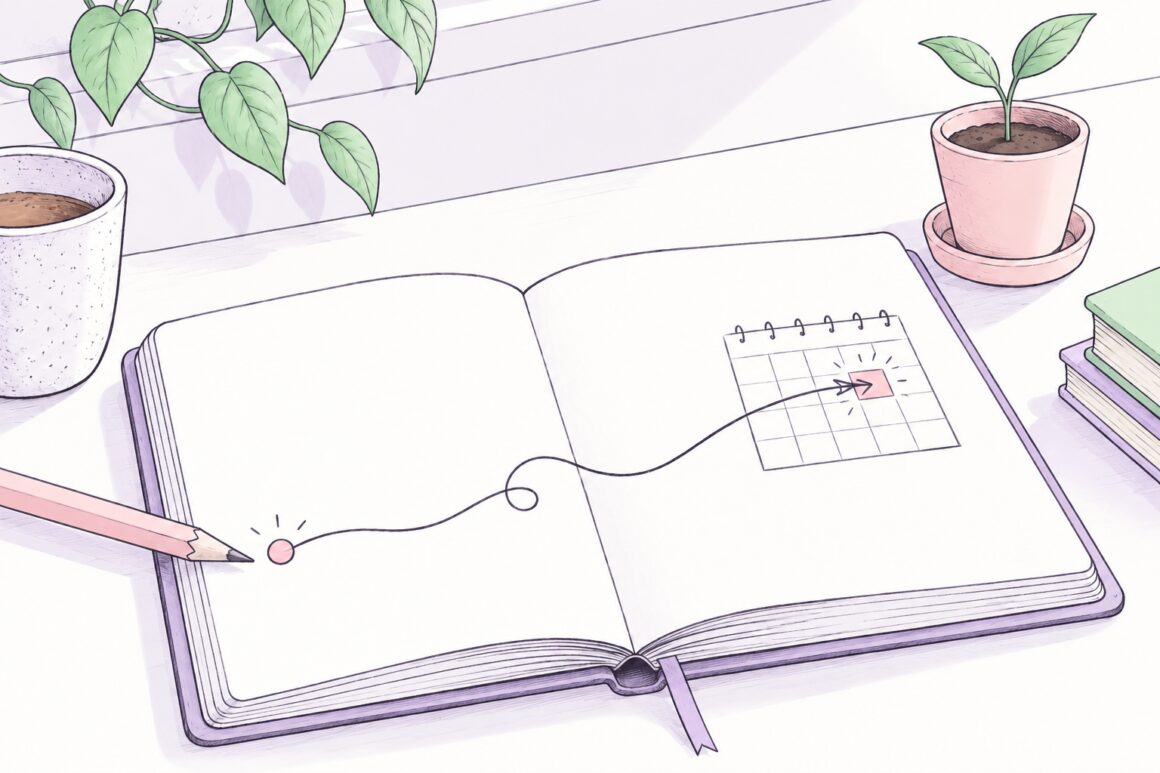
Future-self journaling is a short writing exercise: describe a future you would like to move toward, then work backward to one step you can take now. It can help make a vague goal more concrete. It cannot guarantee that a goal will happen, and it should not be used to pretend that real limits do not exist.

What this exercise can—and cannot—do
Research on “future-self continuity” looks at how connected people feel to their future selves. In one 2018 experiment, participants wrote a letter to themselves either three months or 20 years ahead; the study reported more exercise in the following days among participants whose connection to the distant future self increased. That is a specific finding from one study, not proof that a journaling routine produces lasting change for everyone. This page uses the idea as a planning prompt, not a treatment or a manifestation method. Read the study by Rutchick and colleagues.
Use the exercise to clarify choices you can influence. Other people’s decisions, health, money, work conditions, discrimination, and unexpected events can shape what is possible. A useful plan can account for those realities without blaming you for them.

A 10-minute future-self journaling exercise
Use a notebook or a notes app. Set a timer if that helps. You do not need special supplies, a perfectly positive mood, or a daily routine.
1. Pick a useful time frame
Choose a point far enough ahead to imagine a change, but close enough to connect it with present choices—perhaps three months for a small project or a year for a broader direction. Treat the date as a planning aid, not a deadline you must meet.
2. Describe an ordinary moment
Write a few lines about an ordinary day in that future. What is one thing you handle differently? What routine or support makes it easier? Stay with details that matter to the goal. Skip the fantasy of a perfect life.
3. Separate hopes from what you control
Make two short lists: “I hope for” and “I can influence.” For example, being promoted may depend on an employer; preparing a portfolio, asking for clear feedback, or exploring other roles may be within your influence. Keep the distinction visible so the exercise does not turn uncertainty into a personal failure.
4. Work backward to a repeatable action
Ask what small behavior could make progress more likely. If the future picture is “I feel more prepared in meetings,” a controllable action might be writing one question before a weekly meeting. Choose an action that fits your time, energy, access, and responsibilities.
5. Plan for the obstacle
Name one likely barrier and a smaller fallback. “If I have no time after work, I will spend five minutes choosing a question for the next meeting.” A fallback keeps a busy day from becoming an all-or-nothing test.
6. Choose the next step and review it
Write one action you can take within the next week, when you will do it, and what would make you revise the plan. Review after a week: Did the step fit? What got in the way? Should you continue, reduce the effort, seek support, or choose a different direction?

Example: wanting to speak up more at work
| Prompt | Example response |
|---|---|
| What do I hope is different? | I contribute ideas in meetings instead of leaving with them unsaid. |
| What can I influence? | I can prepare one point and decide when I want to offer it. I cannot control how others respond. |
| What is a small action? | Before Thursday’s meeting, write a two-sentence version of one question. |
| What is my fallback? | If I do not get a chance to speak, I can send the question afterward or ask for time in a later conversation. |
| When will I review? | After two meetings, I will note what felt useful and whether the goal still matters to me. |
The example focuses on practice and options, not a promise that confidence or a particular workplace outcome will follow.
Prompts to adapt
- What would I like to be a little easier three months from now?
- What part of that depends on me, and what part does not?
- What support, time, money, access, or other resources would this take?
- What is the smallest action that would provide useful information?
- What is a realistic fallback for a difficult week?
- What might tell me that this goal needs to change?
When to change or skip the exercise
If picturing the future makes you feel pressured, write from today instead: “What matters this week?” You can also focus on a practical decision, ask someone you trust to help you think it through, or stop. Goals should be allowed to change when circumstances change. A journal prompt is not a substitute for professional support when you need it.
For a short daily reflection, try our five-minute journaling template. To connect a goal with what matters to you, see the values journaling prompts.
Keep the page useful
Save only the parts that help: the future picture, one action, and one review date. If the plan stops fitting, revise it. The point is not to script a guaranteed future; it is to make today’s next choice clearer.