
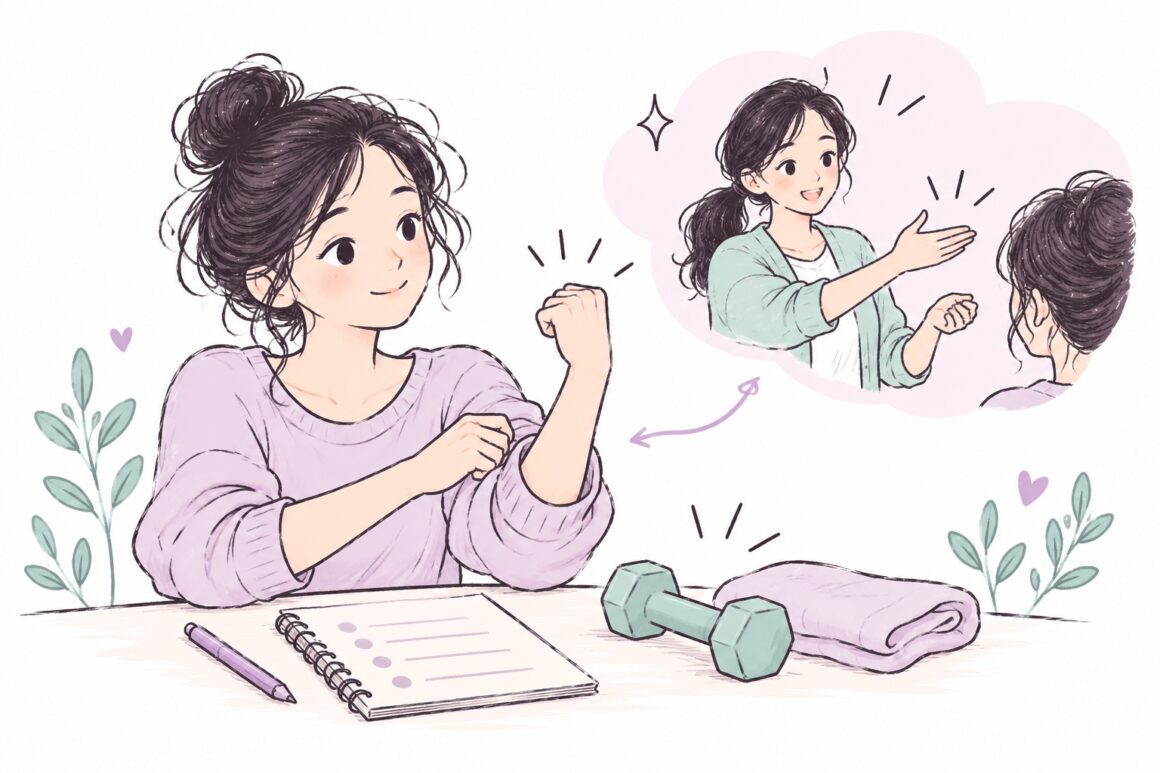
Confidence is not one fixed trait that a person either has or lacks. It often changes by task and setting: someone may be comfortable leading a familiar team but unsure when speaking to a new audience. Understanding that difference helps you choose a useful next step instead of treating every uncertain feeling as proof that you cannot do something.
Confidence, self-efficacy, and self-esteem
People use confidence in several ways. In psychology, self-efficacy refers more specifically to a person’s belief that they can carry out actions needed for a particular task. Self-esteem concerns a broader sense of personal worth. These ideas can influence one another, but they are not interchangeable.
| Term | Question it helps answer | Example |
|---|---|---|
| Task confidence or self-efficacy | “Can I do this particular action in this situation?” | “Can I explain this project clearly in a meeting?” |
| Self-esteem | “How do I generally value myself?” | “Does one mistake change how I see my worth?” |
| Skill or preparation | “What can I currently do, and what needs practice?” | “Have I prepared an example for the interview question?” |

These answers may differ. A person can have relevant skill and still doubt themselves in a particular setting; they can also feel confident while needing more practice. Feelings alone do not measure ability.
What can shape task-specific belief?
Albert Bandura’s self-efficacy theory describes several kinds of information people use when judging whether they can perform an action: their past attempts, seeing others perform something similar, feedback or encouragement, and how they interpret stress or other physical cues. These are influences, not a formula that guarantees confidence. One early success does not prove that every future attempt will go well, and feeling nervous does not prove that failure is inevitable. See Bandura’s foundational paper and the American Psychological Association’s overview.

When confidence is not the missing piece
Hesitation can point to several different obstacles. Check the conditions before deciding you need to feel more confident:
| What is missing? | Useful response |
|---|---|
| A skill you have not practised | Rehearse one small part or get feedback. |
| Information about expectations | Ask what a good result looks like or request an example. |
| Time or access | Ask for a change, support, or a more realistic deadline. |
| Trust or safety in the environment | Pause, document the concern, or seek advice from an appropriate person. |
| High consequences and limited expertise | Get qualified review; confidence is not a substitute for competence. |
Sometimes the best next move is preparation, a boundary, or a decision not to proceed. Treat the setting as part of the problem rather than assuming every hesitation is a personal failing.
Example: speaking in a meeting
Imagine a capable employee who hesitates to share an idea with a new team. “I am not confident” describes a feeling, but it does not identify the obstacle. The person might be unsure how to summarize the idea, unclear about the meeting format, or concerned about how the team handles disagreement. Each possibility calls for a different response: rehearse a two-sentence summary, ask about the agenda, or consider whether the environment is respectful enough for open discussion.
If the setting is reasonably safe and the person wants to practise, they could start by asking one clarifying question or sharing the idea with a trusted colleague first. Afterwards, they can note what actually happened, what they learned, and what support or practice might help. The purpose is to get useful information—not to prove worth or force a larger risk.
A grounded way to use the idea
- Name the situation. Replace “be confident” with a specific action you want to take.
- Check what the task requires. Separate a skill gap from missing information, unclear expectations, or a real external constraint.
- Choose a reasonable next step. Practise, seek feedback, gather information, ask for support, or decide not to proceed.
- Review the result fairly. Record what happened without turning one outcome into a verdict about your ability or worth.

This approach does not require acting before you are prepared. For decisions with serious health, financial, legal, or safety consequences, confidence is not a substitute for sound information or qualified advice. And if a workplace or relationship is unsafe, caution may be appropriate. A useful next step should fit both your goal and the conditions around it.
For a practical worksheet on choosing and reviewing a manageable practice step, see How to Build Confidence Through Small, Useful Practice. If your next step is a conversation, our meeting scripts offer wording you can adapt.